
93% of consumers require your local business to maintain an average Google Business Profile rating of 3+ stars in order to consider choosing your brand for a transaction. While you don’t have to have a perfect 5-star rating to win leads and sales, failure to formalize a plan for reputation defense can quickly result in your brand dipping down into the danger zone.
Fortunately, any local business can swiftly adopt reputation management best practices, whether you’re marketing a single-location small business, or one with hundreds or thousands of doors or service areas. A little planning (and help from today’s article) will help you:
- Prepare review response templates that solve the dilemma of how to respond effectively to negative reviews
- Ensure you know how to act when fake reviews appear on your Google Business Profiles (GBPs)
- Create a chain of escalation for resolving customer complaints
- Diminish the impacts of negative reviews
What negative reviews impact most
There are three essential business assets that are at risk when reputation management is neglected:
- Consumer trust
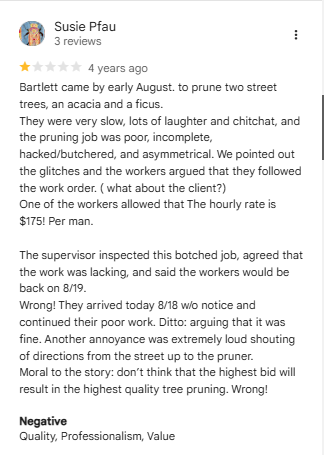
Negative reviews are a matter of public record. When a 1-star review like the above receives no response from the business, trust is lost on two sides:
- The unhappy customer knows they cannot trust the brand because their legitimate complaint has been met with silence and indifference.
- Future potential customers will also doubt whether they can trust the brand because they can see that it ignores its patrons when things go wrong.
- Conversions
Neglected complaints cost brands conversions (consumer actions like calling the business, filling out a form, visiting the website, booking an appointment, or making a purchase). Not only is the initial negative reviewer unlikely to return to the business for repeat transactions, but they are also unmotivated to refer the brand to their circle, depriving the company of valuable leads they might otherwise have earned.
Simultaneously, neglected negative reviews signal to the general public that it may not be worth it to take a next step with them, such as visiting a store or booking a consultation.
- Online local visibility
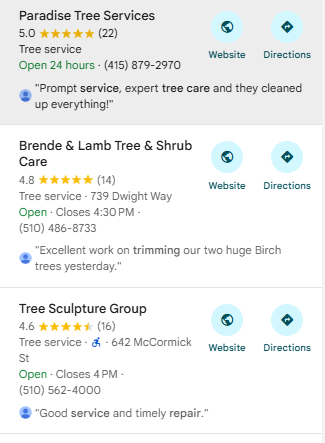
Average star ratings are one of the metrics that are believed to have an impact on rankings in Google’s local packs and Maps. They are just one of multiple ranking factors, and it’s not uncommon to see a business with a slightly lower rating outranking one with a higher rating because some of its other signals are superior, but it’s important for you to know that your rating contributes to your online visibility in the local search results.
All three of these elements emphasize the need for active review management to demonstrate trustworthiness, both to existing customers and potential future ones. No business is perfect and all can expect to receive some complaints – it’s how you handle them that determines whether you are defending or neglecting your reputation.
The “CALM” response framework
When a negative review appears on one of your GBPs, the CALM acronym provides a simple and practical framework for responding. *Note, however, if you suspect that a review is fraudulent, don’t respond and keep reading for advice on how to manage fake reviews.
- Confirm + acknowledge – Via the owner response function, validate that you have read and understood the reviewer’s complaint.
- Apologize – Always offer an apology for the customer’s inconvenience, disappointment, or distress.
- Lead with the next step – Let the customer know you are eager to make things right for them.
- Move it offline – Provide a phone number or other personal contact information, inviting the customer to get in touch with you so you can make up for their poor experience; this not only shows care, but also moves the conversation away from being a lengthy public exchange towards a one-on-one private chat in which you can make your best effort to regain the trust and good opinion of the customer.
If you become adept at the CALM response framework, it can have exceptionally good impacts on your business. Take a look at these statistics from GatherUp’s survey of 1000+ US consumers:
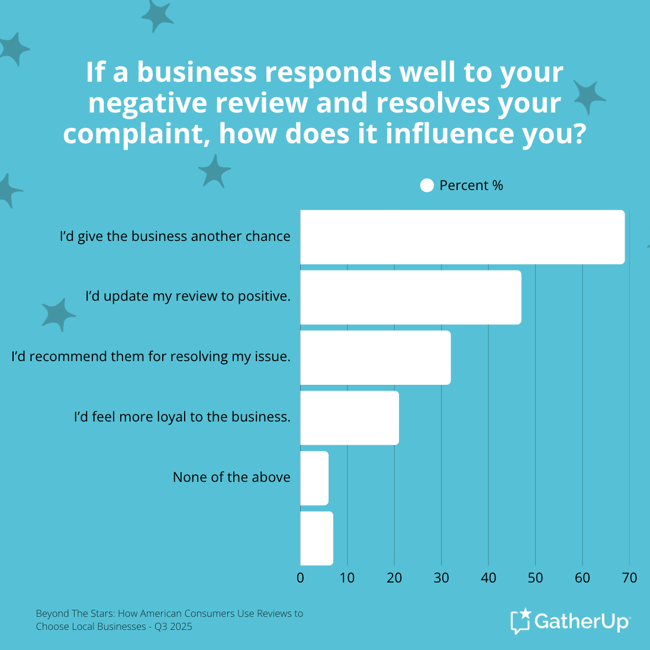
By responding well to negative reviews, 69% of consumers will give your business a second try, 48% will update their negative review and rating to reflect a better subsequent experience, and 32% will recommend your company to their circle because of how you responded when they complained. These figures demonstrate the power of a reputation defense strategy. Instead of negative reviews hopelessly eroding your star ratings, public trust, repeat business and referrals, the right responses can significantly lessen the negative impacts of inevitable complaints.
To enjoy maximum benefits from responsiveness however, you must reply to complaints quickly. To achieve a fast rate of response, you need to know when new reviews come in.
Having trouble keeping up with incoming consumer feedback? GatherUp can help with review monitoring and instant alerts whether you’re marketing your own single-location business, a multi-location enterprise, or multiple agency clients.
5 response templates by scenario
Here are five difficult but common negative review scenarios with a templated response for each that you cut/paste and customize:
- A legitimate complaint about poor service
In a case like this, a negative review mentions something like food being delivered cold, a service team failing to show up on time for an appointment, or a lack of cleanliness at store premises.
Response template for this scenario:
| Dear [reviewer name],This is [business owner name], the owner of [business name] and I want to personally apologize for [what reviewer complained about]. I’m so sorry you experienced this and want to let you know that, since reading your review, I have [explanation of steps taken to try to prevent further customers from experiencing the same issue]. I am eager to make this up to you, if I can, and would really appreciate you contacting me directly so I can try to make this right for you. Please, reach out to me at [email address, phone or SMS line]. I’m grateful you took the time to let me know what happened, and I’ll be hoping to hear from you soon. Thank you. Sincerely,[business owner name, title, and business name] |
- A misunderstanding
Here, a customer is upset because they misunderstood something about the business. For example, they might have been unaware of a company policy, have made a mistake about when they booked a reservation, or have failed to act on a limited time offer within the appropriate timeframe. In this case, the customer is actually at fault, but the business you’re marketing still needs to respond graciously to try to win back their good opinion, and hopefully inspire them to update their negative review.
Response template for this scenario:
| Dear [reviewer name],This is [business owner name], the owner of [business name] and I am so sorry that there was a misunderstanding about [whatever the customer misunderstood]. We do our best to [whatever the business does to make their policies and offerings clear], but I completely understand that you weren’t aware of this and felt disappointed. I would really like the chance to make things right for you and to learn more about what happened. I want every customer to be satisfied. I’d be grateful if you’d reach out to me directly at [email address, phone or SMS line] to see if there’s anything I can do to make this right. I appreciate you taking the time to let me know what occurred and will be hoping to hear from you soon. Sincerely,[business owner name, title, and business name] |
- Complaint about an employee
This is one of the most uncomfortable negative review scenarios, when a reviewer calls out a staff member by name with a complaint. It’s often unfair, because employees are typically only as good as the training they receive from their employer, and it is not very polite to try to publicly shame a staff member who is generally only doing their best to earn a living. In this context, the business owner should never join the reviewer in complaining about the employee, and should never give the appearance of trying to hide behind staff or pass the buck for a poor experience. One of the key goals of responding in this context is to put responsibility back where it belongs – on the shoulders of the business owner.
Response template for this scenario:
| Dear [reviewer name],This is [business owner name], the owner of [business name] and I take full responsibility for the disappointment you experienced. I truly appreciate your business, and am so glad you have taken the time to explain what happened. I would appreciate the opportunity to hear more about this, and to do anything I can to make this right for you. Would you please reach out to me directly at [email address, phone or SMS line]? I hope to have the chance to make this up to you and will be looking forward to hearing from you. Sincerely,[business owner name, title, and business name] |
- No record of customer
In the past, it was common for business owners to check their records following a negative review if the business model is such that customers’ names are on file. For example, if a reviewer named “Bob Jones” complained about a problem during a hotel stay or dental visit, staff could see whether or not Bob Jones is a guest/patient of record and investigate further about when/why the complaint occurred before responding to the review.
However, as of 2026, this workflow has become less effective because Google changed its policy to begin allowing anonymous reviews. Instead of real customer names being linked to reviews, they may stem from anonymous screen names. You can still click on reviewer profiles for signs of suspicious activity (like a single profile reviewing 50 dentists across the United States), but you may not be able to quickly understand the true identity of a negative reviewer. The owner response can help with this new and confusing dynamic.
Response template for this scenario:
| Dear [reviewer name],This is [business owner name], the owner of [business name] and I apologize for the disappointment you experienced. I’m so eager to hear more about what went wrong so that I can do everything in my power to investigate and remediate this issue. I would really appreciate the chance to make things right with you. Would you please reach out to me directly at [email address, phone or SMS line] so I can get the full details of what happened and do all I can to make it up to you? Thank you. Sincerely,[business owner name, title, and business name] |
- Competitor/spam suspicion
Review fraud is forbidden by most review platform guidelines, and is illegal in many nations. Fake reviews are, unfortunately, very common and may stem from a direct competitor, a customer with a personal grudge against you or someone at your place of business, a random person using reviews to write nonsense on the internet, an extortionist, or a shady marketing firm that is making money via review fraud. Unless a review is left directly by a customer describing their personal and legitimate experience with a business, it is typically fraud.
For a complete tutorial on this vital topic, read How to recognize and report your competitors’ GBP review fraud. Here, what you need to know first is that you should not immediately respond to a review you suspect to be spam. For example, if you click on the reviewer profile and see that they have reviewed dozens or even hundreds of other businesses in your category, you will want to report this to the review platform instead of responding. Read the above tutorial to learn how to report such cases to Google.
*Note that if any review alleges illegal or dangerous behavior, you should not respond and should keep reading, but if your case seems like one of simple spam that violates policies like Google’s prohibited and restricted content guidelines, you should file an appropriate report for requesting removal. Unfortunately, platforms don’t always remove spam that has been reported to them, and if all of your efforts fail to result in removal, only then should you respond.
Response template for this scenario:
| This is [business owner name], the owner of [business name] and I have reported this review to [platform name] for removal on the grounds of suspicion of review fraud. |
A final note about responding: do make use of these templates as each scenario arises, but also, make the extra effort to customize them to avoid the business looking robotic and uncaring by pasting the same response to multiple reviews.
When to escalate internally
One of the smartest things any local business can do is to establish a formal customer complaint escalation chain at their place of business. This ensures that unhappy patrons experience in-person resolution as often as possible, minimizing negative reviews, but a chain should also be put in place for managing review-based complaints. Create a plan for the following scenarios:
- Designate response duties
Whether the business is small, large, or working with a third-party agency for review management, review response duties must be clear to ensure that customers are receiving fast and effective responses. A single-location business needs to identify whether the owner will respond, or whether those duties should be assigned to staff members or marketing partners. Chains and franchises need to make the same decision for each location of the business.
If anyone other than the business owner is tasked with review response, education should be provided as to when to escalate a review up the chain to the business owner or to a specific corporate entity. For example, respondents for a restaurant chain may be authorized to respond to all reviews where a diner simply didn’t like the food, but if a complaint occurs about something like a self-serve softdrinks machine being out of order, this can be tagged as something that needs to be escalated to corporate for remediation.
- Handling complaints involving legal liability or public safety
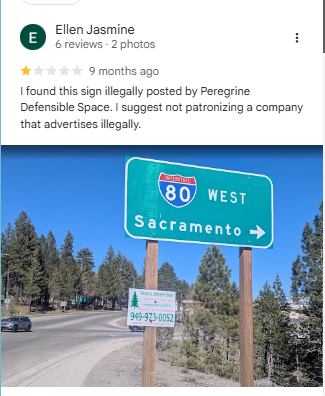
The above is an example of a review alleging business behavior as a violation of laws or ordinances. In such cases, the brand should not immediately respond and should, instead, seek legal counsel to understand how best to proceed. This may or may not end up involving formal outreach to the reviewer for remediation. Don’t confuse marketing advice with legal advice, or take pseudo legal advice from marketers or marketing publications. Instruct all staff or partners who encounter a complaint of illegal or dangerous behaviors in reviews to immediately escalate the review to the highest authority at the business and then speak to an attorney.
- Multi-location reputation defense strategy
Develop a style guide and a response strategy playbook for all branch managers and franchisees tasked with review response to defend the reputation of each location as well as of the overall brand. Your documentation should include:
- Examples of appropriate voice and tone
- Examples of when to escalate a review to corporate
- Examples of how not to respond to reviews
- Examples of review spam and instructions on how to proceed when review fraud is suspected
- Guidelines on expected response timing
- Templates for responding to common review types the business receives
- Clear designation of response duties for each location
Education is key to setting all stakeholders up for success in playing their part in the defense of branch and brand reputation.
Don’t forget the real wins of reputation management
While no business enjoys receiving negative reviews, the right outlook re-frames them as some of the most actionable content your brand can access. When actively managed, negative reviews:
- Are voluntary consumer feedback that lets you know what members of a local community dislike
- Surface patterns of dislikes over time so that root causes can be fixed, ensuring improvements in consumer satisfaction and a better reputation
- Provide an opportunity for the business to respond publicly with the goal of demonstrating to individual customers and whole local communities how well the company takes care of its patrons when something goes wrong, creating a very strong trust signal
- Are not the end of the road – a fast and effective response to a complaint can result in winning back the customer’s good opinion, repeat business, and referrals, and may inspire them to update their low-star review to a higher one, positively impacting your average rating
Reviews are an incredibly valuable form of business intelligence, but you can only make the most of data over time with the right tools.
Ready to defend your reputation with a centralized workflow, with review monitoring + alerts + team workflows + reporting trends? Book a demo with GatherUp today.