
Search is changing fast. Generative AI answers, AI summaries, zero-click results, the whole stack is shifting. But the job hasn’t gone away. It’s widened. If SEO used to be a lane, it’s now a highway with more on-ramps. And here’s the piece too many teams still treat as a side quest: online reviews.
Reviews aren’t just social proof. They’re how people decide, how AI systems “learn” your brand, and how your visibility shows up across Google Business Profiles, AI overviews, and social. That’s not theory. It’s a consumer habit, week after week.
99% of U.S. consumers read reviews.
68% value fresh reviews more than your overall rating.
67% trust Google reviews most.
Nearly half form an opinion after only 3 to 5 reviews.
So while the definition of “search” stretches, the way people build trust is steady. You win more if you keep your review engine running.
What the Panel Got Right and Where Reviews Plug In
In a Search Engine Land interview, the experts made a few points that line up with what we see every day.
1️⃣ “SEO is deprecated” doesn’t mean “disappears.”
It means “different.” Search is expanding beyond ten blue links into answers, agents, and blended results. Your content now lives across web pages, profiles, video, UGC, and yes, review surfaces. Treat reviews as content that feeds both people and machines.
2️⃣ Multimodal is here.
People don’t only read. They scan screenshots, watch 15 seconds of proof, check a quick star snapshot, then scan a couple of recent comments. That’s a review habit, not a blog habit.
3️⃣ Measurement must evolve.
Clicks are messy. Mentions, visibility, and sentiment now matter more. That’s why our clients track input signals (fresh reviews, response time), channel signals (profile views, surfaced snippets), and outcome signals (calls, bookings, NPS).
It’s a cleaner way to show growth when the SERP keeps shifting.
The Reputation Reality: What Consumers Actually Do
Let’s keep this simple.
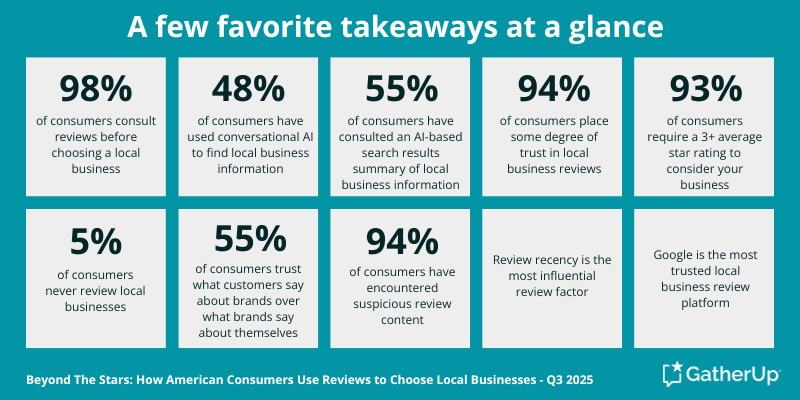
- Recency beats nostalgia. People weigh your latest reviews over your lifetime average.
- Speed matters. Two-thirds of consumers prefer being asked for a review the same day as the service.
- Responses change outcomes.
- 82% prefer businesses that actively respond.
- 73% give a second chance after a thoughtful reply.
- 54% will update a negative review when you resolve the issue.
- 59% won’t come back if you ignore them.
- Real beats robotic. 60% say obvious AI replies reduce trust. Use AI to draft. Add a human finish. People can tell.
- Ratings still gate attention. 43% need at least 4 stars; only 3% are ok with less than 3. That’s a lot of pass/fail before your team ever gets a call.
First-Party + Third-Party: A Simple Framework That Pulls Weight
You need both.
- First-party reviews live on your domain. They’re detailed, they capture context, and they can be marked up for schema. Great for learning and long-tail visibility.
- Third-party reviews live on Google, industry sites, and marketplaces. They’re the trust layer people check first and they influence local rankings and map visibility.
When brands run a steady blend, they see stronger NPS, more stable ratings, and healthier volume.
We’ve seen restaurants double third-party review volume year over year when they requested reviews consistently.
Insurance nearly tripled reviews with the same approach.
What’s Working Right Now (No Fluff)
- Ask across channels. Email + SMS outperforms either alone, 29 reviews per 100 requests.
- Ask fast. Same-day prompts perform better. Introduce the request in person, then send the link soon after.
- Reply like a person. Thank the happy. Fix the unhappy. Simple, sincere replies change outcomes and attract future customers.
- Keep the engine running. Review velocity matters more than one-time spikes. Adopt a weekly cadence; our data shows steady programs correlate with higher NPS.
Your Measurement Shift: From Clicks to Credibility
Here’s a lightweight model to run with your team or clients:
Inputs: New reviews per week, recency, response time, first- vs third-party mix.
Channel signals: Profile views, surfaced snippets, visibility across key sites.
Outcomes: Calls, forms, bookings, and NPS lift.
If you’re an agency, this is how you defend ROI when search formats change.
Our Agency Trends Report highlights “Proving ROI in a fragmented journey” and “Competing in online reputation” as top challenges, shifting to a reputation-first scorecard closes that gap.
How We Set Teams Up in GatherUp
You know what? Tools only help when the workflow is simple.
1️⃣ Connect the plumbing. Add each location, authorize Google, and brand your requests.
2️⃣ Pick the right request flow:
- Survey & Reviews (for richer feedback)
- Ratings & Reviews (for faster lanes)
- Public Review Flow (for volume)
3️⃣ Tune feedback settings. Combine email + SMS, prevent spam to regulars, and define positive vs negative routing.
4️⃣ Make it easy to add customers. Use Client Staff Forms, QR codes, or universal BCC for automation.
5️⃣ Respond at scale without sounding canned. Use Suggested Review Responses as drafts, personalize the last 10%.
For Agencies: How to Win in 2026
Lead with reputation strategy, not just keywords. It’s a clearer story, and a faster path to results.
White-label the dashboards, automate the response workflow, and train your teams to finish human.
Consumers know the difference, and so does Google’s AI.
✅ Quick Start Checklist
- Turn on email + SMS requests.
- Set weekly review goals per location.
- Train staff to “plant the seed” in person.
- Reply to every review within 48 hours.
- Report Inputs → Channel → Outcomes.
Search Got Noisier. Trust Did Not.
If you keep reviews fresh, respond like you mean it, and measure what actually signals confidence, you’ll stay visible across Google, AI answers, and the places customers already look.
That’s the work. It’s also the win.
💡 Ready to make reviews your agency’s growth engine?
GatherUp helps multi-location brands and digital agencies automate review requests, respond authentically, and prove ROI when search changes.