
Every month of 2025 contained so many local SEO developments, it was challenging just to keep up with the news. Online local business reviews, in particular, saw significant changes. A quick read through this post will ensure that you’re caught up on major rollouts that will shape the 2026 reputation management landscape. There are lots of new opportunities here to influence local consumer purchasing decisions via professional review management!
- Google Maps Content Trust & Safety Report
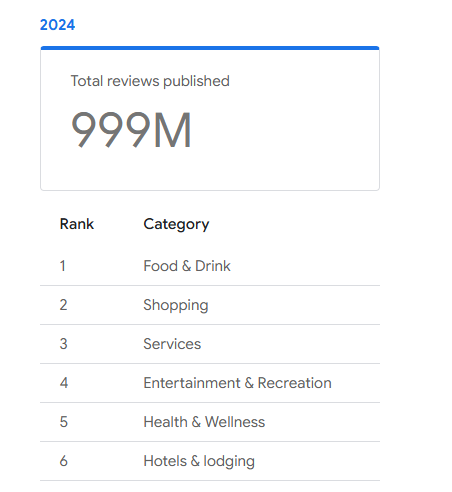
Google kicked off 2025 with a significant report on local business review activity in the foregoing year. Google shared that nearly 1 billion reviews had been published by their system, and that the most-reviewed business categories were Food & Drink, Shopping, Services, Entertainment & Recreation, Health & Wellness, and Hotels & Lodging. They also revealed that 94 million public edits had been made to local business listings with most-edited fields being name, location, hours, address, category, and website address.
Google documented their removal of 245 million reviews, 169 million photos and videos, and 70 million listing edits. The following table quantifies the reasons for which they removed reviews:
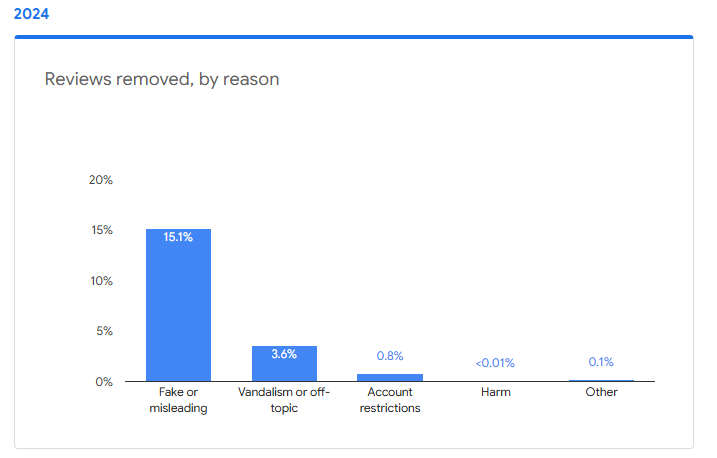
Your takeaways: It takes organization and professional tools to manage consumer public activity surrounding both local business listings and reviews. These are very active and popular Google products. GatherUp finds that 98% of consumers consult reviews before making a local purchasing decision. This is extremely influential content that must be maximized via review acquisition and guarded against fake or misleading information, as well as vandalism and off-topic remarks.
- Reviews as AI Content
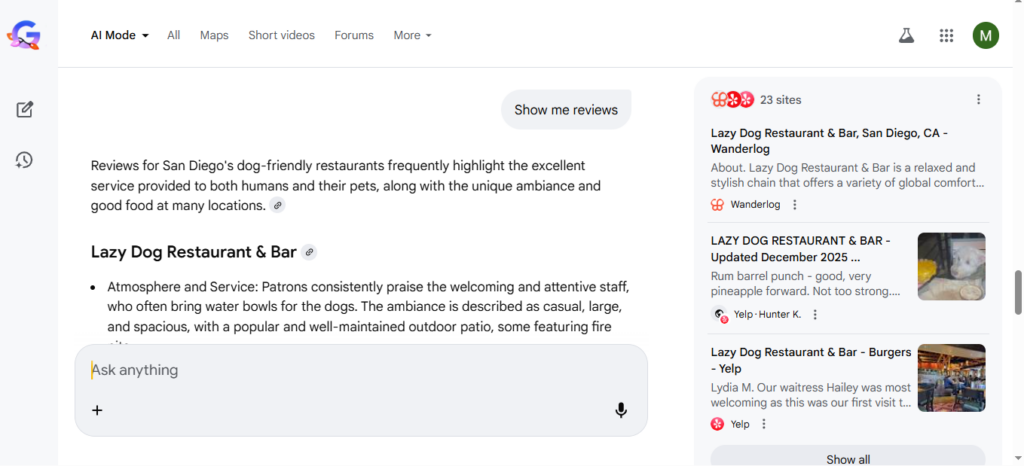
Conversational AI has been the local search market disruptor of the year, bringing both new opportunities for local business visibility and new layers of consumer experience for brands to track for misinformation. As the above screenshot shows, reviews play a big role in the content being generated by conversational AI environments like Google AI Mode and ChatGPT.
Even if consumers don’t opt into an AI chat, they may well encounter AI-generated content in the form of Google AI Overviews, right in the organic search engine results:

Meanwhile, Google is vigorously experimenting with AI-based features in the Google Maps app that is the default local search experience on Android devices. In addition to publishing AI-based review summaries, they are rolling out features like this “Know Before You Go” section that is scraping information from reviews, websites, and social media content:
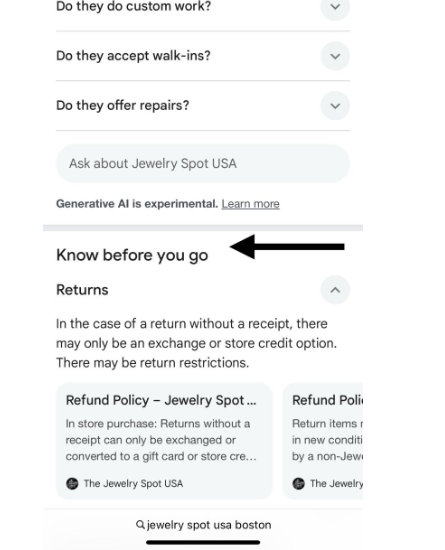
Your takeaways: Given AI’s worrisome habit of generating false information, a core task in 2026 will be to ensure you are earning sufficient reputational content across all the platforms popular AI tools are scraping from so that they have sources to cite instead of just making up nonsense about your brand in response to user prompts. Come up with a list of questions local consumers are most likely to ask about your business and see how you’re being represented across conversational AI and AI SERP features, as well as how Google is summarizing and surfacing information about your brand in the Google Maps app.
- New Google Maps Review/Photo Carousel

Darren Shaw was among the first to capture Google’s beginning-of-the-year rollout of an interesting new carousel layout of photos + review information in the Google Maps app. Clicking on the review snippets in the carousel generates popups of further content, including:
- Photos or videos related to the review snippets
- Pricing information
- Keywords, often pulled from Place Topics that summarize the most-mentioned topics within reviews
- More reviews mentioning the same attributes
Your takeaways: Templatizing review requests that ask customers to give feedback on specific aspects of your business as well as encouraging them to upload photos with their reviews is likely to be one of your strongest tactics for 2026. Detailed, illustrated reviews enable very granular information to be highlighted in displays like the carousel example. This content helps Google match your listing and reputation to a variety of searcher intents, increasing your company’s chances of being chosen for transactions because there are textual and image-based proofs that you offer specific goods and services.
- Google prompting your reviewers for more information
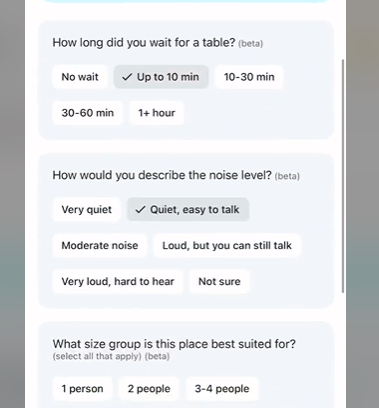
Claudia Tomina documented Google’s rollout of new questions being asked of consumers when they leave reviews of local restaurants. Some of these new questions include:
• The wait time experienced by the customer
• The noise level at a venue
• The reviewer’s opinion on the size of group a particular venue is suitable for
• Seating options offered to patrons
Your takeaways: It’s very likely that this information is being used to train the AI-based “Ask Maps” feature that rolled out in Q4 2024. Reviewer opinions will be more influential than ever before because of Google’s choice to make them central to the Google Maps experience. Not every patron is going to want to take the time to answer a series of questions, emphasizing the need to have a continuous review acquisition program underway at your brand so that at least some percentage of customers will be willing to leave full feedback for Google.
- A Final End to School Reviews
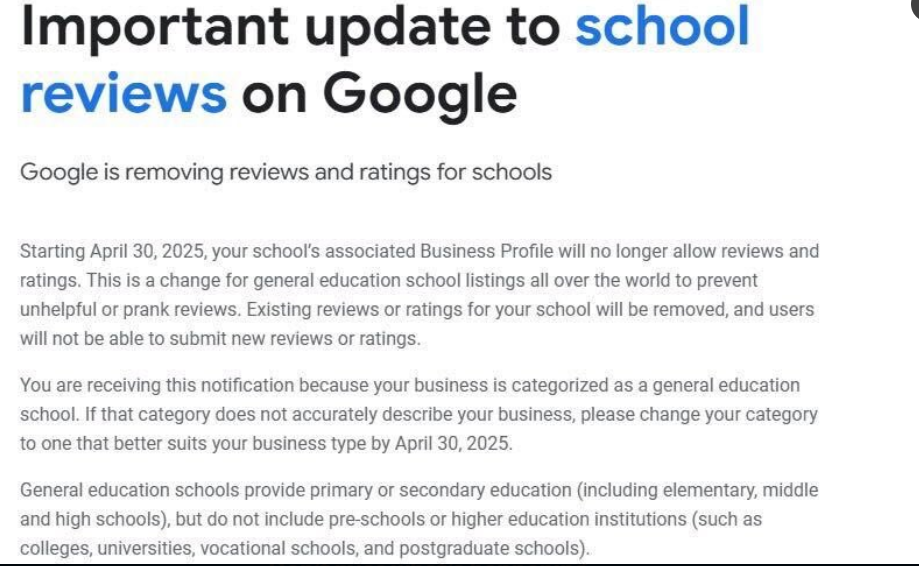
Vinay Toshwinal captured this announcement from Google that they would begin removing all reviews from general education schools’ Google Business Profiles in the spring of 2025. This remedied a problematic scenario of longstanding. Google had previously removed the ability for the public to leave new reviews for these institutions, meaning that listings only contained old content rather than current reflections of the schools’ reputations. Meanwhile, new schools could not effectively compete with review counts or ratings because they had no way to earn them. By removing all reviews, Google acted to level the playing field.
Your takeaways: While it was good to see Google address this historic review problem, it’s important to know that review restrictions don’t apply to all types of schools. For example, universities and daycare centers can still receive reviews. For more on this, read the Understand reviews policies for schools section of this Google help doc to discover whether a business you’re marketing is eligible to be reviewed by the public.
- New Spam & Review Bombing Tag
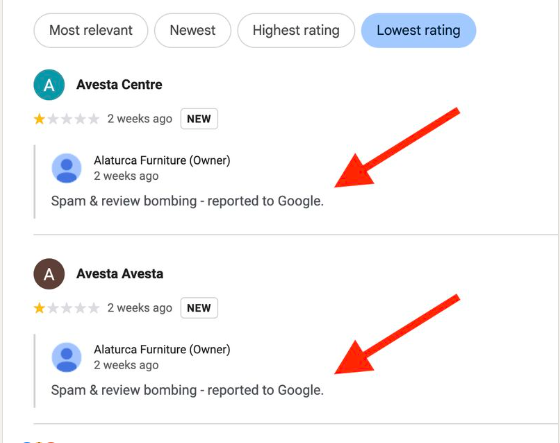
Elizabeth Rule caught sight of the new public warning tag labeled “Spam & review bombing – reported to Google” in October of this year. This tag indicates that the business owner has reported apparent review spam, and that Google knows about the report but has not yet acted on it. In an ongoing conversation I’ve been having about this with Elizabeth, it is somewhat concerning that this tag has been sitting on these reviews for several months with no further action on Google’s part.
Your takeaways: Local business owners and their marketers are in general agreement that it would be a good thing if Google would act with more urgency when a Google Business Profile is being spammed with fake reviews. Despite the number of reviews removed shared by Google in their Trust & Safety reports, review fraud is a massive problem. The Transparency Company finds that consumers are suffering $300 billion in annual economic harm in the home services, legal, and medical categories due to review fraud.
At the very least, the new Spam & Review bombing tag could alert some consumers to the fact that some of the reviews they’re seeing on the Google Business Profiles of shady brands are not trustworthy. Given the scale of review fraud, local businesses should be actively monitoring their listings for signs of spam and vigorously reporting these instances to Google.
- New Review Extortion Guidelines

One of the most insidious forms of review fraud involves bad actors leaving negative reviews on local business listings and then contacting business owners to demand money in exchange for removal of this content. Google has finally become sensitive enough to the scope of this problem to create guidelines for reporting review extortion scams to them. In setting out to take the above screenshot, the “Important” label Google has had to add to this page suggests that they are being inundated with reports of this kind, indicating the scope of this problem.
Google’s guidelines urge business owners to gather evidence and to follow the following steps:
- Do not engage with or pay the malicious individuals. This can encourage further attempts and doesn’t guarantee the removal of reviews.
- Do not try to resolve it yourself by offering money or services.
- Gather all evidence immediately. The sooner you collect proof, the better.
- Report all relevant communication you receive in the form.
Your takeaways: While this is a step in the right direction when it comes to Google facing the extortion dilemma in their review product, local business owners and their marketers have been quick to point out that the new guidelines create a new problem. The types of evidence Google requires for these reports may necessitate the business owner communicating with the extortionist, even though Google’s guidelines say not to engage in this manner. My best advice is to seek legal counsel as your first step if you are contacted by an extortionist, before you respond to them or file a report with Google.
- Google Invites Anonymous Reviews

Google walking back their long-standing policy of wanting real names on Google accounts and then couching their invitation to anonymously review businesses in “Secret Santa” language raised some red flags in the local business community that has become increasingly aware of the problem of review fraud. Given the scale of review spam in Google’s local products, enabling anonymous reviews hardly seems like the search engine is taking real-world harms seriously. Yet, this announcement may not be quite as bad as it seems at first glance.
Your takeaways: The main pro of anonymous reviews is that businesses in sensitive categories may now experience an uptick in review volume because clients can now leave feedback under a pseudonym. This development is actually good news if you are marketing a brand in a category like legal.
The main con is that fraudsters now have a new way to try to cover their tracks by creating countless Google Business Profiles that no longer have to look like they belong to real people. While this sounds absolutely terrible, the one thing you need to know is that even pseudonym profiles will still be attached to a record of all the reviews they have left. So, if Google’s suggested “Eager Elf” profile has left reviews for 100 different car dealerships across the United States, you will still be able to spot that suspicious behavior for reporting purposes.
The one capability anonymous reviews deprives brands of is the fact-checking step certain types of businesses frequently do to see if a reviewer’s real name exists in the company’s client files. For example, in the past, a dental practice was able to see that a negative review from John Jones was likely fake because they do not have a patient registered under that name. Now, dental practices and similar business models will have zero idea whether “Eager Elf” is a client or not. There’s no way to put a good spin on this decreased visibility, and this Google development does, indeed, show a lack of consideration for real-world business outcomes.
- New Form for Reporting Business Conduct

Yet another development in the review fraud department puts business owner conduct in the spotlight. If a customer is offered incentives in exchange for reviews, or feels that a business is unduly pressuring them to leave feedback, they can now report this to Google. The new form enables consumers to highlight the Google Business Profile of the offending business and provide some basic details about the incident.
Your takeaways: Review fraud is illegal in the United States and many other nations, and can carry very heavy civil penalties. It is never worth it to offer any type of incentive in exchange for reviews, which can speedily lead to reputation disasters and business failure. There are plenty of legitimate ways to increase review volume and recency to positively impact your reputation, rankings, and revenue. Never engage in any practice forbidden by Google’s prohibited and restricted guidelines.
That being said, it’s important to know that the rollout of the “Report Business Conduct” form did cause some concern in the local SEO community. One of the long-standing tactics for increasing reviews is to request them face-to-face at the time of service, provided you are not using a kiosk/review station to acquire this content. In fact, GatherUp finds that 49% of consumers approve of in-person requests at the time of service:
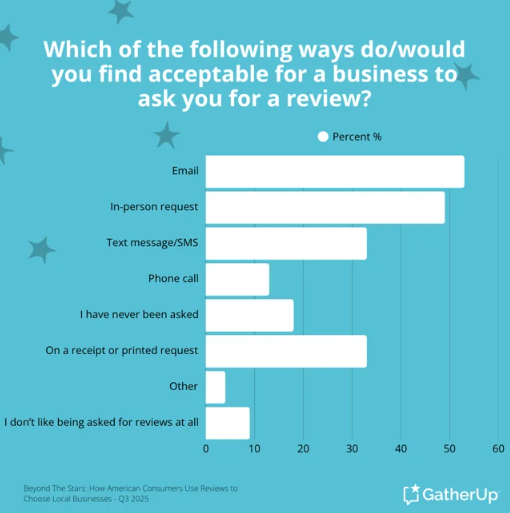
This is why some alarm bells went off when Claudia Tomina posted the following incident on Linkedin:

If Google took issue with a business for “asking for reviews at the register”, then this calls into question the best practice of requesting reviews at the time of service. This is a scenario I strongly recommend you pay attention to in 2026 to see if further reports of review loss are tied to this type of activity. We can’t draw a conclusion from a single report, but your brand should definitely stay tuned on this one.
- GatherUp news
GatherUp is an industry leader in the field of reputation management solutions, making its acquisition by the Insight Integrity Group big news. Putting GatherUp under the same umbrella as The Transparency Company comes as a welcome development for local businesses who are increasingly aware of the serious problem of review fraud and the urgent need for better tools for monitoring and reporting spam.
Further, GatherUp published the 2025 edition of its annual report, Beyond the Stars: How American Consumers Use Reviews to Choose Local Businesses. This unique consumer survey contains hundreds of real-world insights for readying your brand for expert reputation management in the new year.
On the agency side, GatherUp partnered with Promethean Research for an in-depth study of the ROI of adding reputation management as a managed client service. Reputation is proving a major winner in the nascent AI dynamic, and if your agency is deliberating how to expand your menu of client services, we hope you’ll read the report for a good forecast on profit potentials.
Summing up
2026 is going to be a fascinating year. Right now, both local businesses and their marketers are scrambling to figure out how deeply new AI interfaces will impact online consumer journeys. Early days takeaways are that reputation-based content will make up a significant portion of your AI footprint. There are new opportunities for visibility, new features to optimize for, and new challenges to face. GatherUp is committed to standing at the fore of all these developments to offer the right solutions to local brands seeking growth.
Request a demo today to see how we can help your local business or agency, and please allow us to wish you the very best of success in the New Year!