
Do we actually agree on what “agentic search” means in the local search context?
In talks with peers and in reading industry articles on this topic, I’ve realized that there isn’t actually a clear consensus on this. In fact, if you’re hearing a lot about “agentic search” and “agentic AI” at the moment, you and your marketers should know that the definition of such terms may be more nuanced than you’ve previously considered.
Today we’re going to clarify:
- Why different people are defining these terms differently
- Whether local brand reputation plays a role in this type of consumer activity
A Holistic Definition of Agentic Search in the Local Business Context

Would you be startled if someone told you that you’ve been having agentic experiences since the dawn of internet searching? This sounds a bit odd, until you consider that, according to Google, a core definition of “agentic” is that it’s task-oriented, helping people get things done.
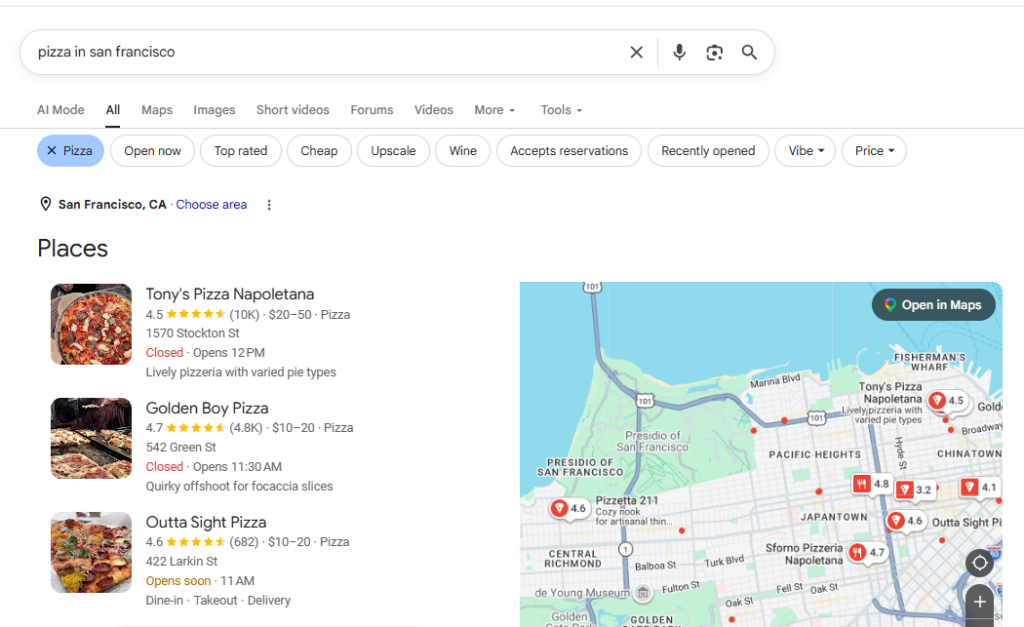
From a 10,000 foot view, then, you began using agentic technology the day you stopped hauling out a phone book to manually look up local businesses and, instead, asked Google’s bots to fetch that information for you via a typical local search:
In this broadest definition, any type of search activity could be considered agentic, because you are using a technological agent to undertake a task for you so that you don’t have to do it manually.
- Very basic example: you look up the weather where your niece lives in New York and Google gives you the forecast, rather than you having to drive or fly across the country to discover the answer for yourself.
- Local search example: you look up “pizza in San Francisco” and Google gives you a local pack of nearby restaurants, saving you from having to walk around the city discovering all your options.
We’ve all been engaging in these kinds of activities for years!
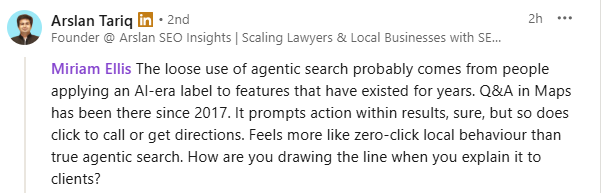
In fact, when I asked my digital marketing peers to talk with me about how they are defining agentic search, this comment from Arslan Tariq is very illuminating about why agentic search may not feel so very new to local businesses owners and their marketers:
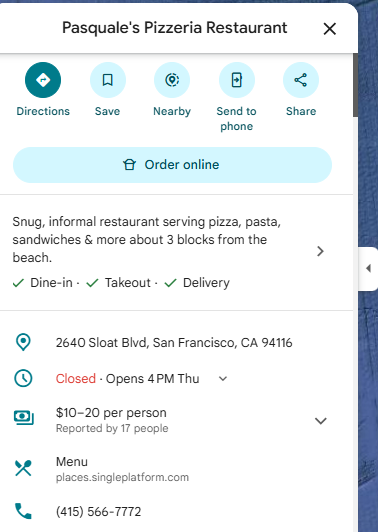
It’s quite correct that Google Business Profiles/Google Maps listings have long offered consumers the option of having agents do things for them like:
- Click-to-call – Instead of the consumer having to have a phone number saved to their phone or written down somewhere and then calling that number manually, an agent will call the number with the click of a button
- Click-for-directions – Instead of the consumer having to memorize the locations of all businesses in their town or consult a paper map, an agent can describe how to get to the business from the user’s location at the click of a button
- Click-to-website – Instead of the consumer needing to memorize the URL of the business or phone them up to ask what their website address is, a simple click does the navigation for the user, taking them directly from the listing to the website
In sum, the concept of having bots/agents carry out tasks for humans can legitimately be said to be as old as search.
A narrower definition of agentic search in the modern era
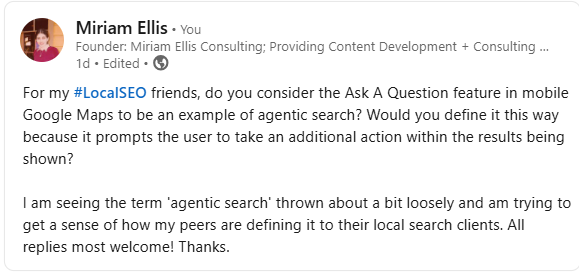
I asked the above question on Linkedin because I had begun to suspect that some of my peers were defining various emergent local search features as agentic search, while others were not. In particular, I wanted to know whether my colleagues would define the mobile Google Maps Ask Maps/Ask a Question feature as agentic.
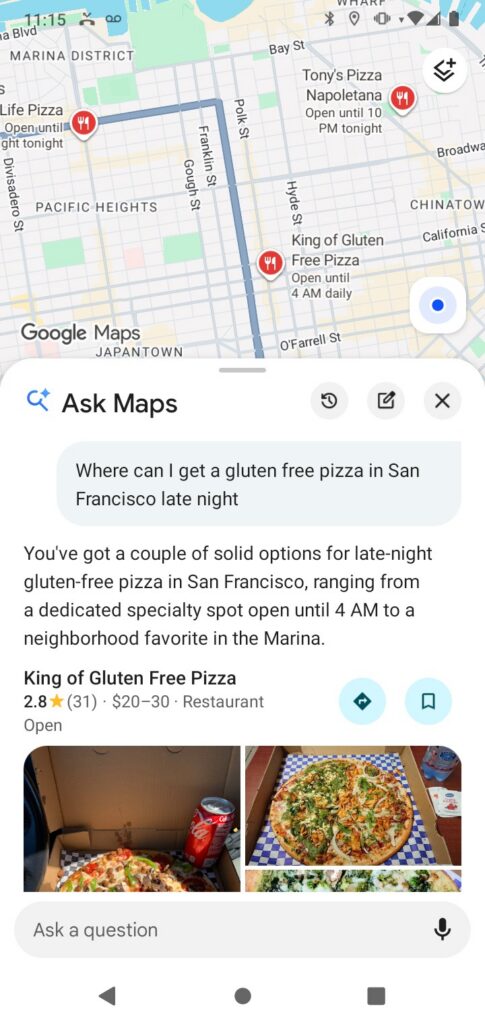
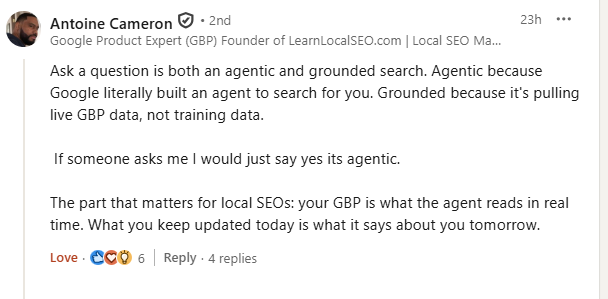
By our broadest definition, we are asking an agent to undertake the task of fetching information for us about where we can get a gluten-free pizza in San Francisco late at night, instead of us manually phoning up a lot of restaurants around the city ourselves. In fact, some marketers like Google Product Expert Antoine Cameron offer a highly nuanced explanation of why Ask Maps can be considered both a grounded search because it is pulling live GBP data instead of AI training data as well as an agentic search because “Google literally built an agent to search for you”:
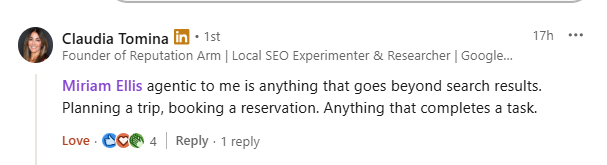
However, what emerged from my launching this conversation on Linkedin is that what many marketers currently mean when they talk about “agentic search” would match Claudia Tomina’s narrower definition:
And Greg Sterling’s explanation of why he doesn’t consider Ask Maps to be agentic:
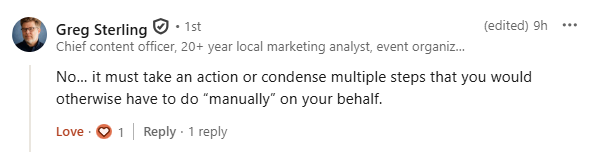
As we’ve seen, we could make a sensible argument that something like a “click-to-call” button should meet these definitions of being agentic because it both condenses multiple steps (like searching your phone or your refrigerator magnets for a phone number) as well as because it completes a task (calling a business at the click of a button).
The Ask Maps feature could also be said to condense multiple steps and complete a task because it is preventing you from having to look up a bunch of different information manually or by phoning businesses to find out where you can get a late-night gluten-free pizza in San Francisco.
My take is that Google is leading the conversation on what truly qualifies as an agentic feature, and that the new capabilities they are rolling out under this heading are what many local search marketers mean when they talk about agentic search. Keep reading!
Google’s definition of agentic features
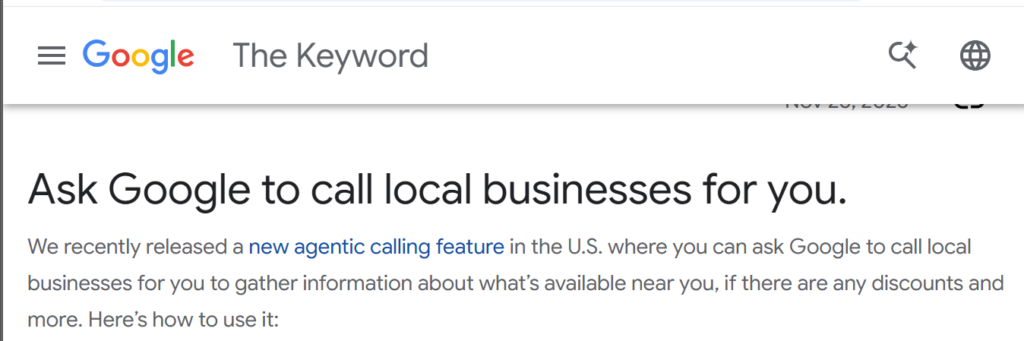
I’ve come to believe that what Google is trying to promote when releasing new agentic features could be defined as agents doing more for humans than they have in the past. This encompasses tasks like:
- Prompting agents to call multiple local businesses for you to gather information, such as whether they have products in stock, what their open hours are, what their quote rates are, etc.
- Using the agentic “track price” checkout feature to make purchases on your behalf with Google Pay when a price fits your budget
- Using the AI Mode “share” button to collaborate with friends and family to make plans
- Using the virtual try-on technology to picture yourself wearing garments
- Using agentic booking for restaurants and travel
- Using agentic browsing assistants to act on your behalf across a variety of repetitive tasks
This final point offers a good definition of what Google appears to think the value add of agentic capabilities really is, as summarized in the following screenshot:

This is familiar ground for any local business owner or marketer who has ever pitched a product or service on the basis of convenience. In sum, my best take on Google’s own definition of agentic search is that agents can now do more for humans than previously, and that the UVP of this is that it saves people time.
Does local business reputation play a role in agentic search?
The simple answer is “yes”; your reviews and broader reputation matter in the agentic era.
The more complex answer is dual:
- Because agentic features are being heavily couched in AI environments like Google AI Mode, basic reputation signals like average star ratings and individual consumer sentiments contribute to which businesses and information are returned as results by Ask Maps and related capabilities.
- Some agentic features will require you opting into programs to enable functions like agentic checkout.
We are currently in the early days of agentic search, but many marketers are making predictions like this one from Claire Carlile:
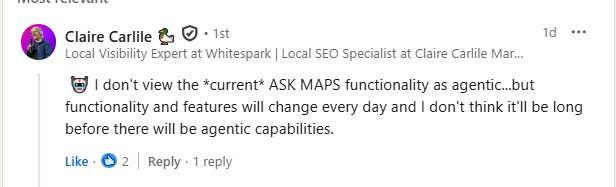
When we ask where Google is heading with all this, it seems likely that they are envisioning a future in which a user may begin in an AI-driven environment like Ask Maps, but then authorize an agent to complete tasks for them like researching a specific menu offering, booking a restaurant table, and paying for it, all while the consumer has gone on about their day, doing other things.
Is this a realistic picture? We’ll be exploring the potential future of agentic search in the local search context next. Come back soon!