
Does your reputation defense playbook contain every possible tactic for protecting your powerful average star rating?
You may already know that 93% of consumers require a 3+ average star rating on your Google Business Profiles to consider doing business with you, according to GatherUp’s consumer behavior survey of 1000+ US adults.

The lower your rating, the fewer transactions your listing will drive your way, and if your brand is dipping down into dangerous territory, be sure you are checking off all 5 of these basic and advanced best practices:
The best way to avoid negative star ratings and reviews is to offer superlative customer service. Rewarding a great experience is the #1 reason members of the public feel motivated to write reviews.
A second facet of reputation defense involves responding to every negative review you receive, offering to make things right for the customer. 54% of negative reviewers will improve the rating they left you if you respond effectively with a solution to their complaint.
A third essential practice is continuously auditing your Google Business Profile (GBP) for signs of fake reviews that violate Google’s prohibited and restricted content guidelines. Review spam has become rampant due to the emergence of global review fraud farms. Run a free scan now to assess the degree of suspicious content in your reviews so that you can report potential fake reviews to Google.
An advanced reputation defense capability involves regularly monitoring your nearby competitors’ GBPs for signs that they may have engaged fraudsters to artificially boost their star ratings. The power of your reputation can be severely limited when spammers use forbidden and illegal tactics to outrank you in Google local packs and Maps. Defend your whole community from review fraud with GatherUp’s new Review Defense offering, which automates both competitor spam detection and reporting.
A fifth vital tactic is to ensure that you are adhering to all of Google’s guidelines so that you minimize the loss of legitimate reviews that could have contributed to your positive average star rating. Avoiding spammy review acquisition tactics is the best way to have as many of your reviews as possible go live on your listings.
All 5 of these components are standard and can contribute to the local brands you market maintaining a strong average rating, but there are also two significant problems every business owner has to face:
- According to GatherUp’s consumer behavior survey, 46% of negative reviewers won’t improve the poor rating and sentiment they left you, even if you make your best effort to win them back with a solution-driven owner response.
- Google routinely refuses to remove obvious review spam, no matter how much evidence you may offer that fake reviews violate their guidelines.
The end result of these challenges is that you may be stuck with both negative and fraudulent reviews sitting on your profiles, reducing your average ratings and decreasing consumer engagement with your GBP, conversions like clicks-to-call and clicks to your website, and, ultimately, sales.
But this picture may not be quite as depressing as it looks from this description, because there is a lesser-known sixth reputation defense tactic you can put into action today. Keep reading!
Review recency: a sophisticated answer to frustrating limitations
Feeling roadblocked by hard-to-please negative reviewers who refuse your offers to make things right and/or by Google failing to uphold their own guidelines and remove fake reviews you’ve reported? Then these statistics may add a welcome silver lining to your cloudy-looking sky.
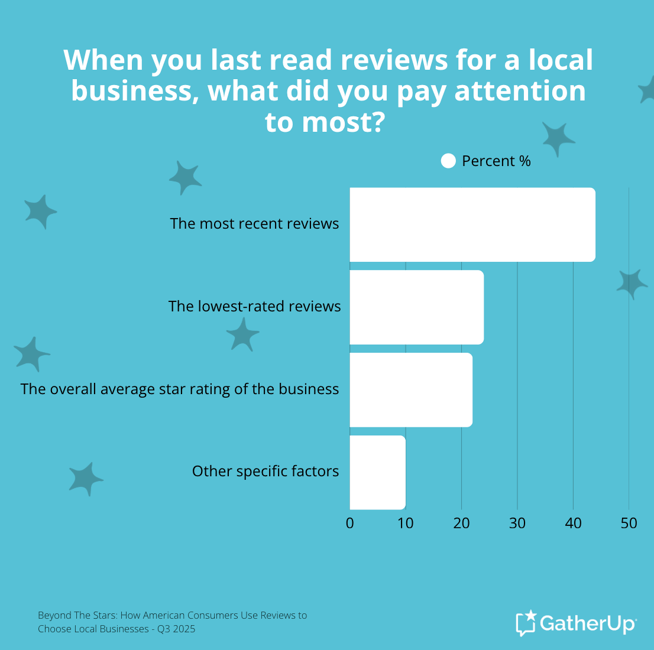
Comprehensive consumer behavioral surveys frequently turn up nuanced insights. While it’s true that your average star rating impacts customer decision-making and is strongly believed to be a local search ranking factor, it is also true that your most recent reviews get the most attention from 45% of the consumer public.
This is nearly half of your potential customer base caring more about recency than ratings.
And frankly, this stat shows the intelligence of local business customers.
Why? Because Google’s average star rating system has a huge flaw. It combines all of the individual ratings a business has received since its GBP was first created. In the real world, that’s a problem. Imagine all the things that can happen to a single business over the course of three years, or five, or ten, like:
- Getting off to a rough start when first opening doors because kinks haven’t yet been ironed out, leading to some early days negative reviews
- Struggles and shutdowns linked to past COVID-19 lockdowns, generating uneven consumer experiences involving inventory gaps and uncertain hours of operation
- Environmental disasters like fires and floods that may have similarly led to consumer complaints while service was disrupted
- Briefly employed, problematic staff who were later fired, but not before their behavior led to a rash of negative reviews
- Changes of management for both bad and good, leading to periods of fallen customer service standards at some point in the past
- Past controversies, such as viral news stories which led to the business being unfairly targeted by random members of the public instead of being honestly reviewed by legitimate customers
- Changes of policies, as in a business improving some aspect of its customer service guarantees to earn more trust and loyalty; poor reviews from before this upgrade remain attached to the GBP
- Changes at the premises, as in improved sanitation standards or the implementation of desirable amenities; again, negative reviews dating prior to these upgrades continue to impact the average star rating
All local businesses go through good days and bad ones, and if they are lucky enough to stay in business for multiple years, their operations can continuously evolve to better meet local consumer demand. The average star rating reflects the entirety of such journeys, and that simply may not be useful to a major percentage of consumers.
After all, if I want to buy a cup of coffee with oat milk, I need to know if my neighbors were able to enjoy this beverage with your cafe this week or this month. It’s irrelevant to me that you didn’t offer plant-based beverages two years ago.
In a nutshell, while you can’t remove the roadblocks of intractable negative reviewers who refuse to give you a second chance and of Google failing to remove obvious review fraud, you can minimize these damages by doubling down on review recency.
The Review Recency Reputation Defense Recipe
Sometimes, you need to give yourself permission to walk away from problems you can’t solve. If you’ve exhausted every avenue for removing the two roadblocks we’ve discussed, take a proactive stance by turning your attention to increasing the frequency at which your brand receives new reviews.
All of these paths to more consistent review recency are open to you:
Renew your commitment to collecting customer contact data at the time of service; acquire as many email addresses, phone numbers, and text numbers as you can to facilitate review requests
Coach all forward-facing staff to request more reviews, but don’t engage in any type of employee review-earning contests, as these are prohibited by Google’s guidelines
Audit your premises, vehicles, and physical assets to discover new places to promote how much your business appreciates reviews; think store signage, menus, receipts, flyers, vehicle signage, billboards, etc.
Regularly launch new initiatives that create public excitement (like highly-publicized new menu items, events, and offers) to inspire fresh reviews from engaged customers
Run month-over-month experiments to discover which review methodologies (e.g. in-person requests, email, text, etc.) yield the highest volume of reviews
Run month-over-month experiments to discover review request time-frames (at time of service, same-day, next-day, one week out, etc.) that yield the highest volume of reviews
At the enterprise level, share institutional knowledge with all branches of the business regarding improving review recency so that multiple locations can benefit
Train and follow-up with franchisees to ensure that review acquisition practices are maximizing recency
Recognize regular customers who left you a review one or more years ago? Ask them if they would be willing to update their reviews with fresh sentiment reflecting their current satisfaction
Audit the competition to determine which competitors have the highest legitimate review velocity and evaluate what is causing their customers to contribute so much fresh content; determine whether new inventory, amenities, services, or other qualities could be offered by your business to match and surpass the appeal of competitors
This is a big checklist, filled with opportunities for almost any local business. But there are challenges here, too, including the fact that:
- Small business owners may simply be too busy to carry out all of this work
- Multi-location business owners may find it difficult to scale all of these processes across their enterprises
GatherUp can help! Our own institutional knowledge has proven to us that the bedrock of achieving optimal review recency is a professional and organized review acquisition that can scale from a single business location to dozens, hundreds, or thousands of them.
The #1 reason more consumers don’t write reviews after patronizing a local business is because they forget to, and 72% of customers will write reviews at least some of the time when asked. These are opportunities you can systematize with the right reputation management solution. The world of reviews isn’t perfect, but maximum review recency can make up for a lot of flaws.
Book a live one-on-one demo now with GatherUp to give our team a chance to show you how we can improve your brand’s recency metrics, or start your free trial today!