Key takeaways
- Negative reviews happen. Every business gets one eventually, and that’s okay. What happens next is usually what people remember.
- The best negative review responses are calm, human, and make the reviewer feel heard.
- Gather the information you need, then reply quickly, within 24 hours, with the full context.
- Templates are a starting point. Say it in your own words.
Negative reviews happen. If you own a business, you will get one at some point, and that’s okay.
What happens next is just as important as that customer’s experience. Future customers will read your reply right alongside the review. Handle it well, and you can solve the problem for this person and show everyone else what kind of business you run.
The best negative review responses are calm, human, and make the reviewer feel heard. Here’s what to keep in mind, plus 10 templates you can start from.
Why do businesses get negative review responses wrong?
Someone reading the review online doesn’t know what happened. So it’s easy for a business owner to want to react, give their side of the story, and explain to the world what happened. At the same time, it feels like this is their one spot to respond to this person.
So the instinct is to reply right away, while you’re still reading the review. However, that’s how you end up with responses that:
- Look rushed. Bad grammar, misspellings, and a tone that says it was written in a hurry.
- Blame the customer. The business takes it personally and accuses the reviewer of something, or makes the bad experience their fault.
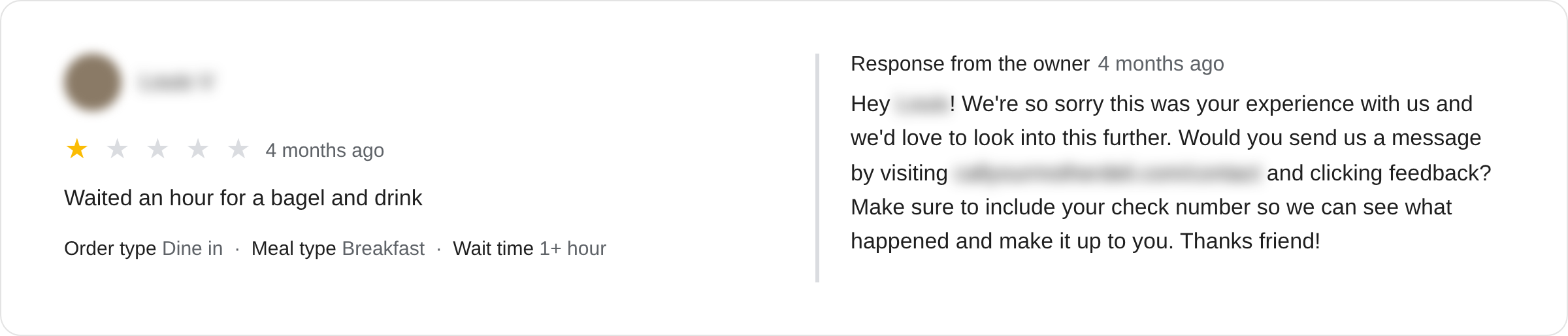
- Say way too much. While researching this post, I found a business that replied to a negative review with paragraphs and paragraphs. I can’t think of a single situation where that much information in a review response would be necessary, or would help the business.

Should you respond to every negative review?
Yes. Responding to negative reviews keeps a line of communication open with the person who left the review. It also means future customers see both the 1-star review and your response when they’re looking at your business.
It’s easy to be good to your customers when everything is sunshine and daisies. Negative reviews show people how you act when it isn’t. And people are less inclined to work with a business that can’t handle hard feedback.
Several industry reports back this up:
- 80% of consumers are more likely to use a business that replies to all of its reviews (BrightLocal, 2026).
- If a negative review goes unanswered, 59% of consumers say they would never return (GatherUp, 2025).
There is one exception. If a review is extremely hurtful or derogatory, don’t respond to it. Report it to Google instead (more on that below).
Some industries also have regulations that affect how they can respond. We’ll cover those below.
How fast should you respond to a negative review?
Respond to a negative review within 24 hours. That’s a good rule of thumb, and it matches what customers expect: 36% want a reply within one day, and another 30% within three days (GatherUp, 2025).
But use that time. Read the review, then go for a walk before you respond.
Before you put anything on the record, collect the information you need. Talk to whoever was working that day. Pull up your records if you need to. Then figure out what comes next. Do you need to reach out to this person offline? Is there something to fix? Gather that information first, then write the reply.
What should negative review responses include?
Negative review responses should do four things:
- Be human. Thank them for the feedback, or say you’re sorry to hear they experienced that. Google’s own advice is to “address the reviewer by name and acknowledge their specific feedback” (Google).
- Empathize. Make them feel heard. 69% of consumers want an apology in a reply to a negative review (GatherUp, 2025). You can empathize with the person about their experience without agreeing with every detail.
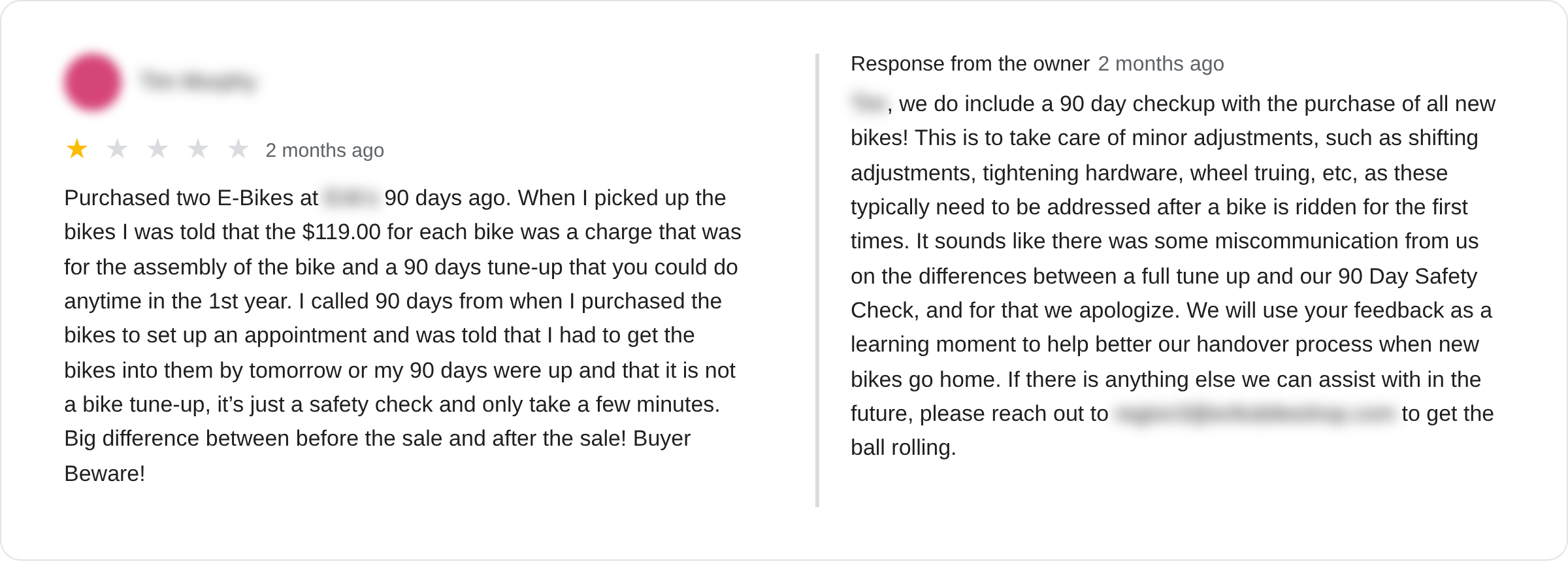
- Share the policy, if one applies. If a business policy shaped what happened, say so. Policies about safety, or about making sure every visitor has a good experience, are the most useful to explain. For example, a salon with a policy for guests who are late to appointments, so the next guest isn’t kept waiting.
- Take it offline, when it makes sense. “We’ve reached out separately and would love to chat.” Or “Give us a call and ask for Susie in the office.” 67% of consumers want an offer to make things right (GatherUp, 2025).
Sharing a policy does two things. It gives context to what the reviewer experienced. And it shows your commitment to a good experience for every customer. Other people reading it can understand what kind of business you are and decide if you’re the business for them.

Two cases that change the rules
When privacy comes first. In regulated industries like dental, medical, legal, and financial services, you may not be able to confirm that the reviewer was ever a customer. So the response has to stay more generic and general. Don’t mention a visit, an account, or any detail from their file, even if they shared it first. Any business where privacy matters can take this approach, even outside a regulated industry. You can choose to keep every reply general.
When a team responds instead of the owner. If you manage reviews at a corporate level, or an employee responds instead of the business owner, you’ll likely use a more standardized template. That’s fine. Make the next step standard too, like a specific email address or a specific link where the reviewer can follow up.
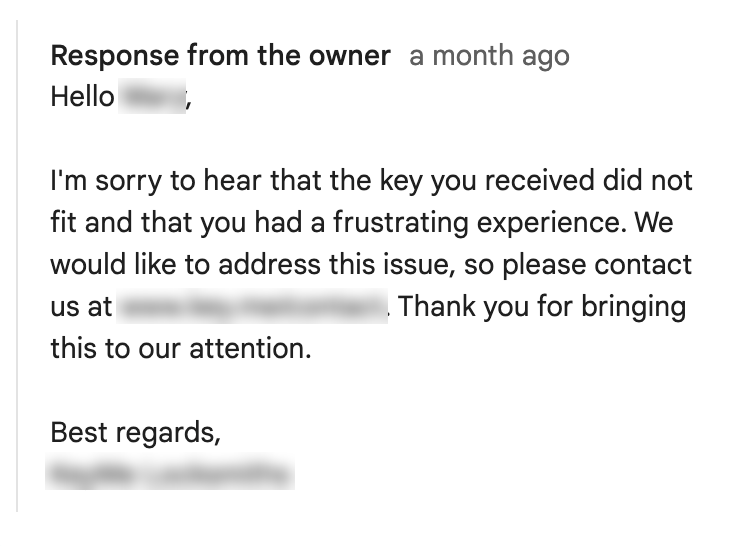
What should you never say in negative review responses?
Never argue, blame the customer, share their private details, or offer something in exchange for changing the review.
| Do | Don’t |
|---|---|
| Thank them for the feedback | Share details about their visit, order, or account |
| Apologize for their experience | Argue about the facts in public |
| Own the mistakes that were yours | Take blame for things outside your control |
| Explain a policy in plain words | Accuse the reviewer of lying |
| Keep it short | Write paragraphs and paragraphs |
| Proofread before you post | Reply while you’re still angry |
And don’t offer a discount or gift to get a review changed. Google’s policy bans reviews driven by incentives (Google Maps content policy), and the FTC says paying customers to change or remove truthful negative reviews may violate the FTC Act (FTC, 2024). You can ask someone to take another look after you’ve fixed the problem. You can’t make a perk depend on it.
For more examples, see How NOT to Respond to Reviews: 10 Pitfalls to Avoid.
Negative review response templates
These negative review response templates are a starting point. Say it in your own words.
At a minimum, use the reviewer’s name and a line that shows you read it, like “thanks for your feedback” or “I’m sorry to hear you experienced that.” You can still have a little nuance there. Half of consumers are turned off by replies that feel generic or copy-pasted (BrightLocal, 2026).
Then decide how your business wants to handle it. You might send the same response to every 1-star review. Or you might change it based on what each review actually says.
Not every reply needs to end with “reach out to us.” Mix it up.
1. General bad experience
Hi [Name], thank you for sharing this. I’m sorry your visit didn’t go the way it should have. We’ve shared your feedback with the team so we can do better next time. – [Your name]
2. Long wait or slow service
Hi [Name], I’m sorry about the wait on [day]. Your time matters, and we fell short. Since then, we’ve [added staff on Saturdays / changed how we schedule appointments]. We hope you’ll give us another chance. – [Your name]
3. Rude or unhelpful staff
Hi [Name], I’m sorry to hear you experienced that. Everyone who walks in should feel welcome. I’m talking with our team about what happened, and I’d like to follow up with you personally. You can reach me at [email]. – [Your name], [Title]
4. Policy or billing complaint
Hi [Name], thanks for your feedback, and I understand the frustration. Our policy is [explain the policy in one plain sentence]. We have it in place so [the reason, e.g. every guest gets their full appointment time]. I’m sorry it wasn’t clearer up front. – [Your name]
5. Product or work quality problem
Hi [Name], I’m sorry [the product / the work] didn’t hold up the way you expected. We stand behind what we do. I’ve reached out separately so we can make this right. – [Your name]
6. We made a mistake
Hi [Name], you’re right, and I’m sorry. We [got your order wrong / missed your appointment], and that’s on us. We’ve already [what you changed]. Thank you for telling us. – [Your name], [Title]
7. One-star rating with no text
Hi [Name], we’re sorry to see you weren’t happy with your experience. We’re always working to improve, and we’d welcome the chance to hear more. – The [Business name] team
8. When privacy comes first (regulated industries)
Thank you for your feedback. To protect privacy, we don’t discuss any individual’s care or account online. We take every concern seriously. If you’d like to talk, please call our office at [phone] and ask for [role, e.g. our office manager].
9. Corporate or multi-location team
Hi [Name], thank you for your feedback, and we’re sorry to hear about your experience at our [location] location. Please contact our customer care team at [email or link] and mention [location], so we can look into this. – [Business name] Customer Care
10. Reviewer you can’t find in your records
Hi [Name], unfortunately, we can’t find a record of you in our files. If you have questions, please reach out to us at [phone or email].
What if the negative review is fake?
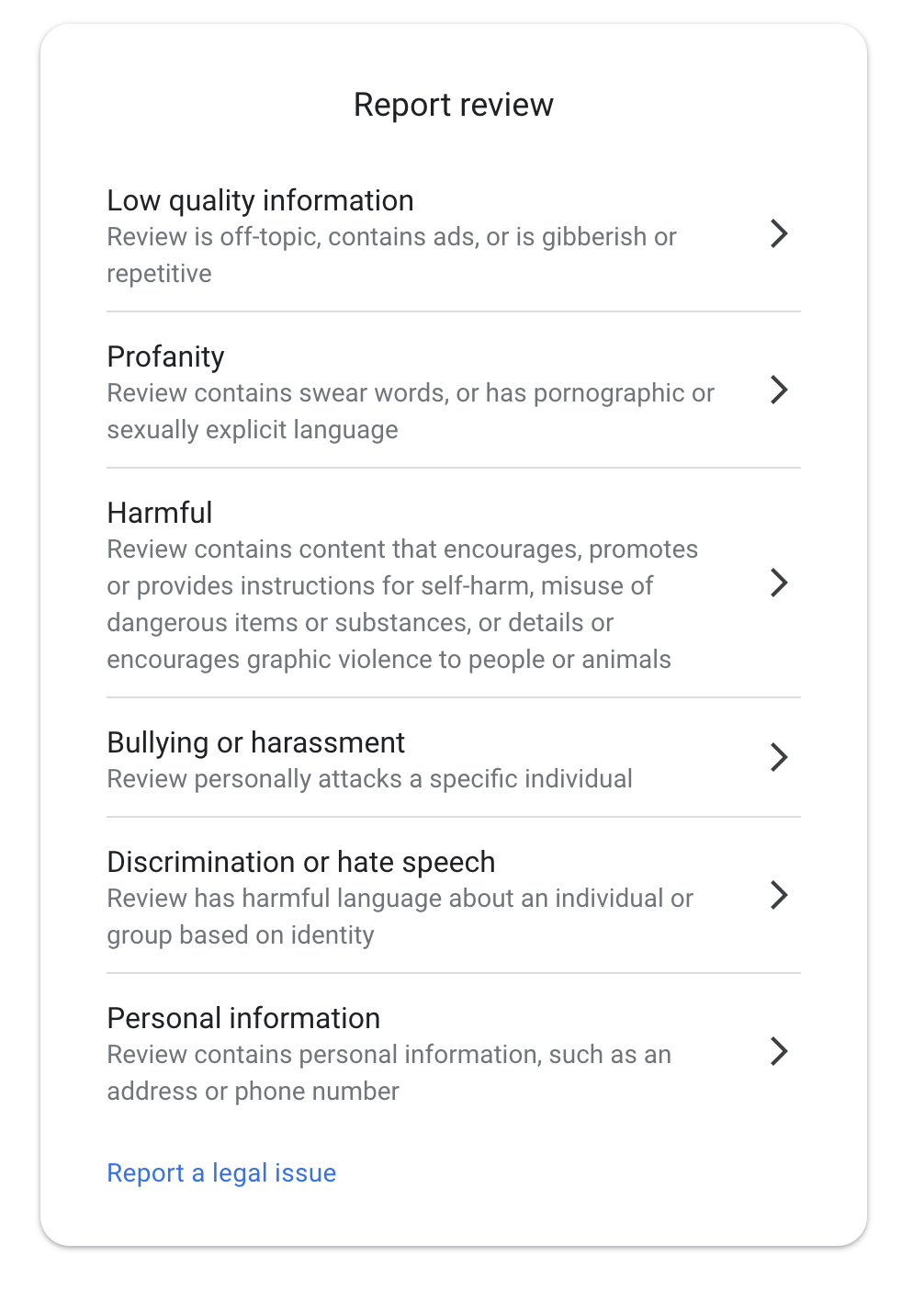
If you believe a review is fake or violates Google’s policies, report it first, before you respond. Responding is up to you.
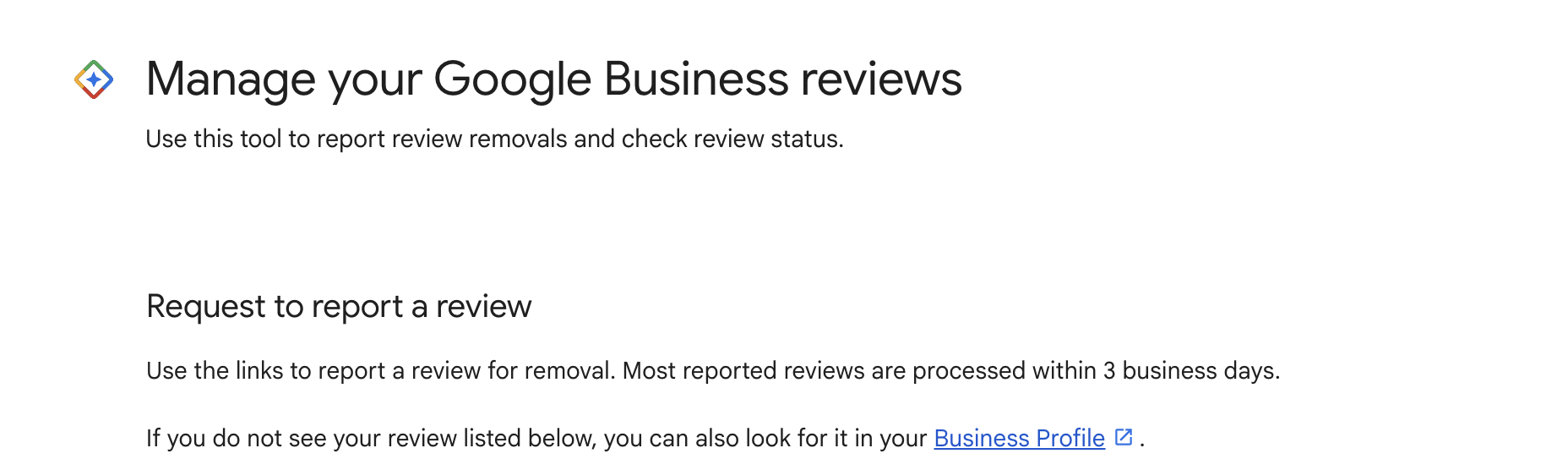
You can also report reviews and check on the status of a report in Google’s review management tool. Google says most reported reviews are processed within 3 business days.
Google removes reviews that break its Maps content policy. The categories that come up most for local businesses are:
- Fake engagement. Content not based on a real experience, including paid or incentivized reviews.
- Conflict of interest. Reviews from competitors, current or former employees, or anyone with a stake in the business.
- Off-topic. Posts about something other than an experience at that location, like political or social commentary.
- Harassment, hate speech, or offensive content. Threats, personal attacks, or unsubstantiated accusations of wrongdoing.
- Personal information. Someone’s private details shared without consent.
- Profanity. Obscene language used to offend.
- Advertising or solicitation. Promotions, links, or contact details posted as a review.
- Repetitive or unclear content. The same review posted multiple times, or text that doesn’t mean anything.
Some businesses still feel the need to respond while the report is pending. If you do, keep it matter of fact, like template 10 above: “Unfortunately, we can’t find a record of you in our files. Please reach out if you have questions.”
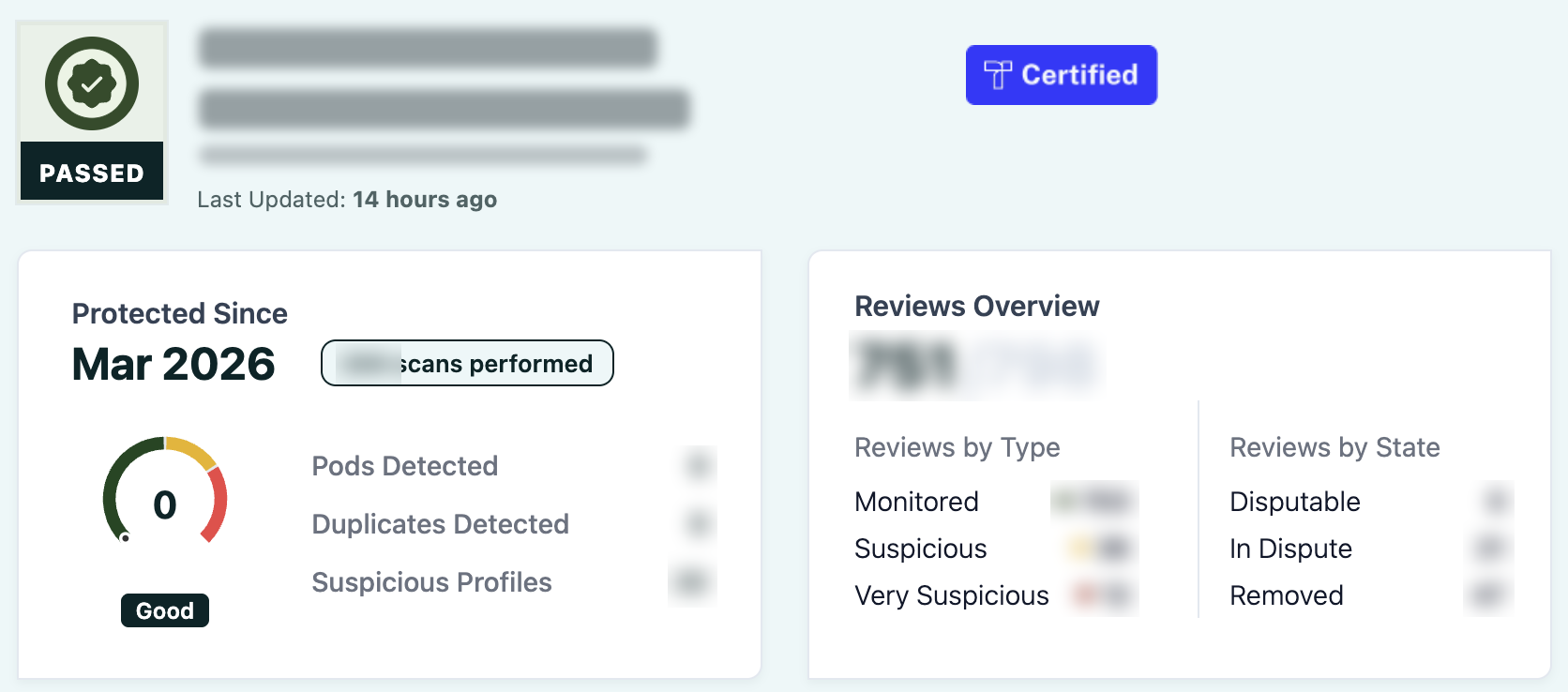
You can always dispute reviews with Google yourself. GatherUp’s Review Defense helps by flagging the reviews most likely to be removed by Google, and by helping you dispute them. For the bigger picture, see Counting the true cost of unmanaged fake reviews.
Is it OK to use AI to write negative review responses?
Yes, you can absolutely use AI to write review responses, or use standard templates. But with negative reviews, there’s so much that could go one way or the other. It’s better to start from a template or an AI draft, then edit it for the specific review.
AI can also help when you’re still heated. Ask it to tone down your language, or to give you feedback on how to simplify what you’re saying.

Just make sure the final reply sounds like you. In GatherUp’s survey, over 6 in 10 consumers said they’re discouraged from leaving reviews if they suspect a business uses AI-generated replies (GatherUp, 2025). See AI Review Responses: A How-to Guide for more on fitting AI into your workflow.
What to do next
Negative reviews happen. Here’s the short version:
- Gather the facts before you reply.
- Reply within 24 hours, calmly, in your own words.
- Take it offline when it makes sense, and follow up.
- Look for patterns. If the same complaint keeps coming up, fix the cause.
Every reply is a chance to solve the problem for one customer and make your business stronger for the next one.
For a deeper playbook, including when to escalate internally, read Defend your reputation on Google: how to handle negative reviews.
Frequently asked questions
Can you delete a negative Google review?
No. Only Google can remove a review, and only if it breaks Google’s content policy. You can report a review you believe violates the policy from your Business Profile.
Should you respond to a negative review publicly or privately?
Often both. Reply publicly so future customers can see how you handle it, then follow up privately when you need more information or want to make it right.
How long should negative review responses be?
Two to five sentences. Long enough to make the reviewer feel heard, short enough to read on a phone. Never paragraphs and paragraphs.
Can you ask a customer to change their review?
You can ask a customer to take another look after you’ve fixed the problem. Never offer a discount, gift, or refund in exchange for changing it. That breaks Google’s policy and may violate the FTC Act (FTC).
Will the reviewer see my response?
Yes. Google notifies the reviewer when you reply, and they can still edit their review afterward (Google Business Profile Help).
Want help keeping up with every review, and spotting the ones that break Google’s rules? Request a demo of GatherUp’s review management and Review Defense tools.