No surprise if you’re finding it time-consuming trying to keep up with all the ways in which AI is impacting how you market local brands. Just the past few months have had multiple noteworthy developments you need to be aware of for agile marketing.
Here’s your quickest route to catching up on the topic of reviews and AI to ensure you’re up-to-date on reputation management opportunities:
ChatGPT partners up with Yelp for review data

All your customers using ChatGPT will now be exposed to Yelp branding, reviews, ratings, photos, and business details when they make local queries. It’s an open secret that business owners have had a love-hate relationship with Yelp over the past couple of decades, but take this news as writing on the wall that every local business needs to be sure its Yelp listing details are correct. And, don’t forget, you are never allowed to ask for reviews on Yelp but you can raise awareness of brand presence on Yelp by displaying Yelp reviews on your website and other assets.
Why this matters: Google has done such an effective job of dominating local marketing conversations that it’s easy for smaller competitors like Yelp to end up in brands’ rear-view mirrors. ChatGPT’s app has reportedly surpassed 1 billion global monthly users. If Yelp review content becomes prevalent in this popular tool, it’s a strong signal that local brands of all sizes should be:
- Auditing their listings for accuracy and completeness on Yelp across all locations
- Correcting outdated information
- Analyzing and responding to reviews on this platform
Regulatory news on reviews from around the world
Consumer protections are increasingly vital in an AI-driven era. Be aware of these developments:
- The EU AI Act went into effect on August 2, 2026 – Article 50 of this act prohibits AI systems being used to generate manipulative text, image, audio, and video content, as well as deep fakes. This ruling could target bad actors who are using AI to generate fake review content at scale.
- The Turkish Ministry of Trade has introduced an Amending Regulation forbidding the publication of reviews from non-customers and reducing owner response wait times when responding to reviews on complaint sites.
- South Korea is now enforcing its ruling against the use of AI-generated deep fake endorsements from social influencers and celebrities.
- In the US, multiple cases of alleged violations of the FTC’s Consumer Review rule have emerged in 2026. The FTC’s Final Ruling, announced in 2024, prohibits a laundry-list of deceptive review and testimonial practices. Legal firms and property management companies were among the first to receive letters from the FTC warning of fraudulent review practices.
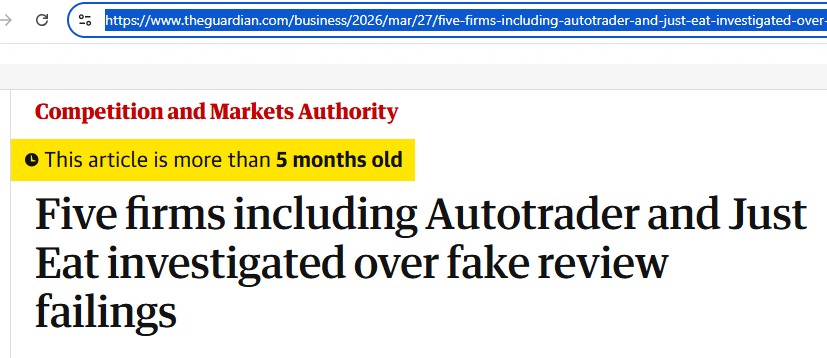
- The UK’s Competition and Markets Authority (CMA) has launched investigations into multiple companies this year regarding the alleged publication of fake and misleading online reviews.
Why this matters: Review fraud causes hundreds of billions of dollars in annual consumer harms, and AI has supercharged bad actors’ abilities to deceive the public with fake reviews, testimonials, and endorsements. Trust in online review content depends on regulation and many governmental bodies are struggling to keep pace with the implications of AI. Where ruling bodies fail to protect consumers, third-party action may be required to defend the validity and trustworthiness of digital reputation content.
LLMs come to the fore in review sentiment analysis
Few bodies of data contain more critical business intelligence than consumer reviews of local businesses. Yet, enterprises with large volumes of reviews struggle to glean sentiment insights manually. LLMs and NLPs come to the rescue in this scenario, enabling brands to bucket sentiment by type, sort legitimate trends of edge cases, and even deconstruct competitors’ reputation management strategies. This summer, NearMedia interviewed Lastmile Retail’s Celeste Gonzales on the use of emergent technologies for gleaning more information from large bodies of review content, and it is a podcast episode well worth watching.
Why this matters: Brands invest large sums in market research and public surveys, but review content is a free asset that is often underappreciated. When properly analyzed, consumer reviews are unsurpassed in their ability to guide customer service standards, improvements to consumer experiences, and many kinds of business decisions.
Ready to put AI to work in analyzing consumer sentiment? GatherUp can help.
Review question prompts the perfect fuel for Google’s AI
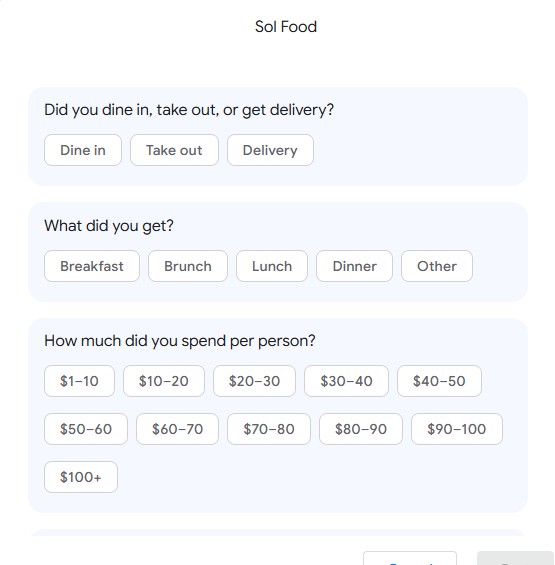
Whitespark conducted a major study of 765 businesses to identify the additional questions Google is asking reviewers to answer in specific industries. Key takeaways:
- About ¼ of GBP categories feature review questions
- Restaurants feature the most questions – a total of 14
- Review questions for service area businesses seem under construction, limited to a couple simple questions like “how much did you pay?” and “which services did you get?”
- The study identified a total of 40 unique review questions
Why this matters: AI is hungry for detailed content and the types of review questions being asked by the Google Business Profile review system seem perfectly designed to fuel Google’s Ask Maps feature that enables consumers to drill down to specific answers to more complex questions. While brands can’t control whether reviewers will take the time to fill out all the review question prompts, they should study the existing questions in their industry and be sure their online content answers them. For example, restaurants have a whole set of questions devoted to vegetarian dining options:
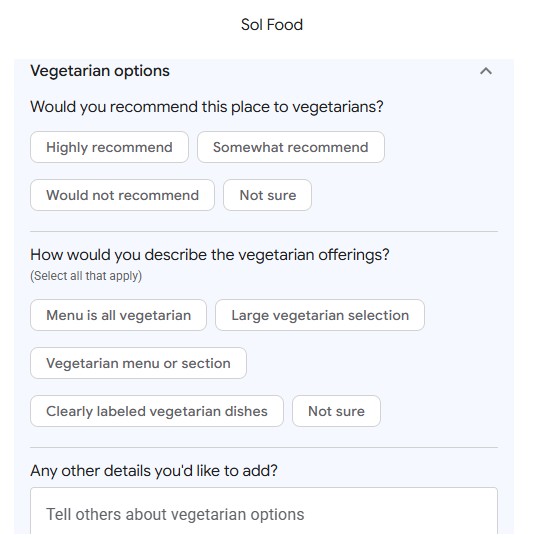
If you’re marketing a restaurant, you should be making the most of your vegetarian menu, the size of your vegetarian selection, the clarity of your labeling of vegetarian dishes, and similar information on your Google Business Profiles, your website, your menus, your photos, your social profiles, and advertising.
Google’s “Tell Maps” expands options for consumer feedback
Kudos to Claudia Tomina for sharing her test of this new agentic AI Google Maps feature which was announced in August:
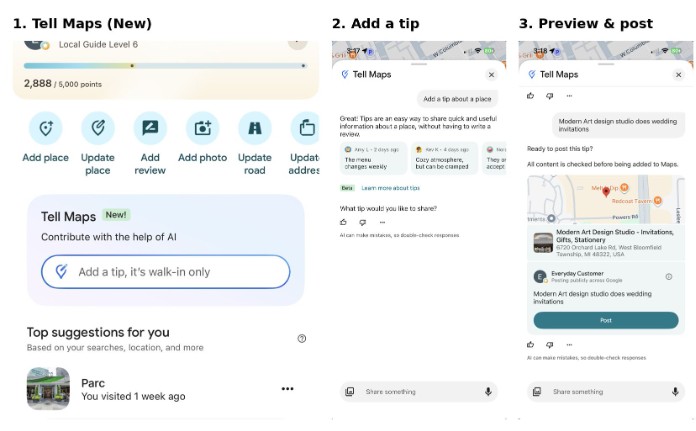
As Tomina explains:
“I tested it this week, and it’s genuinely agentic. Meaning the AI isn’t just answering questions, it’s taking action on your behalf: finding the listing, formatting the contribution, and posting it for you.”
Google’s description of the Tell Maps feature is one all local businesses need to read:
“Insights from over 500 million contributors play a big role in keeping Maps fresh and helpful, and now we’re making it simpler to share updates. You can suggest edits conversationally, right from Ask Maps and the Contribute tab. You can even upload a photo of a storefront sign — Maps will detect the new hours from the image, and ask you to confirm before submitting the suggestion for you.
“As always, Maps’ built-in protection systems review suggested edits for accuracy, and won’t post suggestions that violate our policies. It’s also easy to tell Maps about an insider tip — just say something like “more parking is available behind the building,” and Ask Maps will surface this helpful information to others in the community.”
Why this matters: The test of this new agentic feature is a good reminder never to oversimplify definitions of reputation management. Sometimes, reputation management is merely defined as managing traditional online reviews, when it actually encompasses many different elements of a brand’s digital footprint. Google is now asking consumers to contribute tips in a conversational style, and it’s easy to see how such sentiment could form part of a company’s reputation.
For example, imagine if multiple users contributed Tell Maps tips like these:
“This restaurant is the best-kept secret in town for a romantic dinner.”
“I’ve tried all the Oil Change stops in the city, and these folks are genuinely the fastest.”
“This is one of the only cafes downtown with free parking.”
“They’re not only pet-friendly, but they give treats to my dog when we come in.”
“This shop is so gorgeous you’ll want to do an Instagram shoot there.”
While it remains to be seen how short tips like these will be fully utilized in interfaces like Ask Maps, local pack justifications, AI Overviews, and AI Mode, the announcement of Tell Maps is yet one more sign that Google’s AI is ravenous for content. Earning these types of mentions from customers is now a goal – one that expands the definition of reputation management beyond the more formal scenario of sending review requests.
Google bans internal review competitions, but can AI understand the nuances of this?
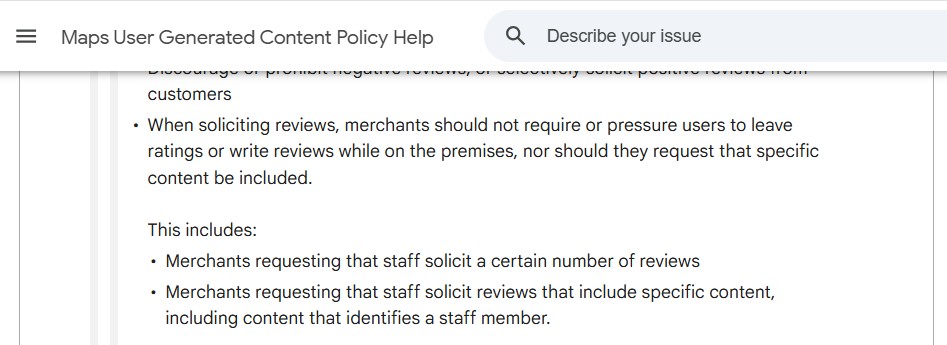
Google has updated its Prohibited and restricted content policy to specifically call out the practice of businesses holding internal review acquisition competitions that rely on staff members being rewarded by the number of times their names are mentioned in reviews. Violations of this guideline could lead to review removal.
Why this matters: In the past, brands you market may have come across the idea of internal review competitions as a smart marketing tactic, but it’s a practice that needs to be abandoned in 2026 because of the negative scrutiny it could bring to your Google Business Profiles. Instead of rewarding individual team members for name drops, why not reward the company as a whole for successfully achieving review acquisition benchmarks?
It’s worth noting that this recent update to Google’s guidelines could prove problematic in the hospitality industry, where it’s not uncommon for legitimate customers to notice waitstaff names on nametags and to praise them (or complain about them!) by name in reviews. For example, this looks like an above-board review, with a photo taken of a meal enjoyed by a diner, and it mentions a server named Rossy:
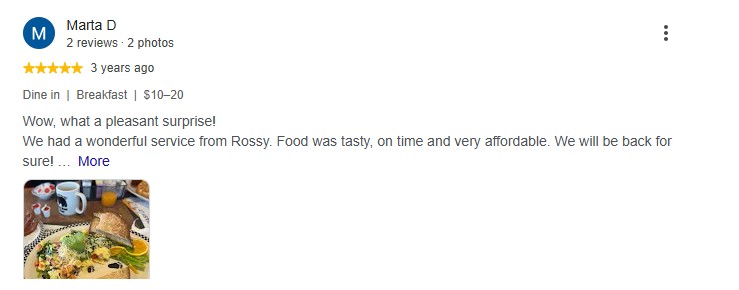
These kinds of mentions have been prevalent in restaurant testimonials for as long as online review platforms have existed. There is, of course, a chance that the waiter asked the patron to mention them by name as a part of an internal contest, but I wouldn’t want to be the judge of this.
In fact, in any vertical in which forward-facing staff wear badges, it’s not unusual for reviews to mention names, and it certainly wouldn’t be fair of Google to punish brands in which this dynamic is a norm. It would be good to know if the AI systems Google is using to vet reviews have internal logic addressing this challenge.
Reviews and AI: your permanent reputation record
It’s an old sitcom trope that students would be warned against doing anything negative that would go on their “permanent record”, lessening their chances of getting into a good college. AI is creating a parallel scenario for brands in which a public record of alleged reputation fraud is readily available to all consumers in tools like Google AI Mode and ChatGPT:
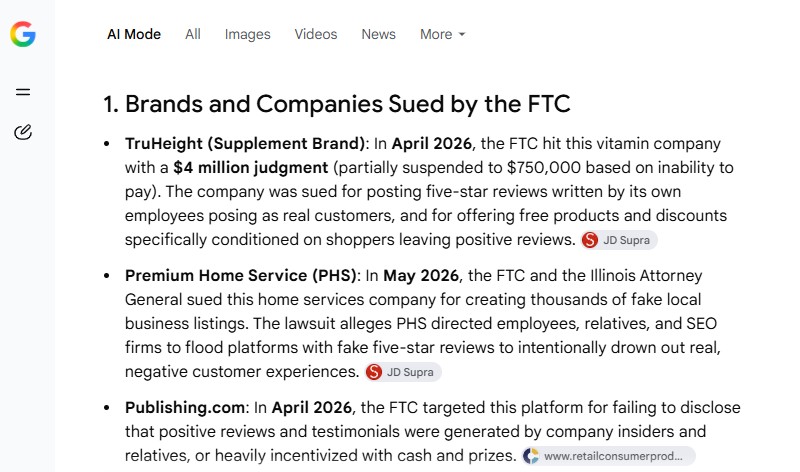
Why this matters: In the past, it was a common practice for brands to pay marketing firms to influence traditional search engine results so that good press about the business ranked highly and bad press was demoted. This enabled enterprises to sweep scandals under a digital carpet. AI disrupts this scenario because it does not replicate ordinal search engine rankings. Any consumer can easily and instantly access any reputation information about any brand, without having to click down through obscure SERP entries buried deep in Google’s index.
And it’s not just a matter of scandals driving human consumers away; if AI agents enjoy widespread adoption, they will be accessing this kind of information to determine which brands to transact with for their human users. It’s never been more risky or potentially costly to break review platform rules or consumer protection laws.
Top takeaway: Every brand has an AI rep, whether they’re managing it or not
In 2026, the definition of reputation management is expanding to cover more and more surfaces as a result of AI. Conversational AI tools like ChatGPT and Google AI Mode put the consumer into a new kind of cockpit where all the controls are within reach for comparing and contrasting the reputations of all nearby brands. Missing answers can equal invisibility, and a reputation for fraud cannot be easily covered up in these interfaces. Motivated brands should focus on:
- Creating the kinds of consumer experiences that inspire patrons to leave positive feedback all over the web, including in emergent features like Tell Maps
- Studying the kinds of questions Google is asking the public and ensuring that the brand has published helpful answers to all these queries on its digital assets
- Rigorously avoiding review platform guidelines violations, reputation fraud, and the long shadows cast by bad press and lawsuits, all of which are extremely visible in conversational AI tools and have the power to drive consumers away
The unwieldiness of AI can be daunting for local business. It can seem like too much to take in, feed, monitor, and influence. Such challenges must be faced, however, because AI will tell your prospective customers what your reputation is whether you are investing in managing it or not. Seize back some sense of control in this novel situation by doubling down on customer service and content publication. Neither is a new discipline. But, as our summer re-cap shows, both are gaining in importance in the AI era.
Wondering what reputation management should look like for your brand or your agency’s local business clients now that AI is part of every discovery journey? Reach out for a conversation and a demo of GatherUp’s reputation management solutions today.