

In developing an active and influential body of reviews for a local business you’re marketing, it can help to think of yourself as setting a table for two:
- At one side of the table, the customer is hungry for detailed evidence about your business to help them evaluate whether you are the best match for their needs.
- At the other side of the table, conversational AI tools like Google AI Mode and ChatGPT are similarly hungry for the necessary evidence about your business to return relevant information in highly detailed contexts.
The good news is that local business reviews can feed both parties exactly what they need. This article will show you why review content sits at the heart of Generative Engine Optimization (GEO) and how your brand can earn more sales by virtue of your attention to detail, especially if your nearby competitors are neglecting this emergent table for two. Share this post with your in-house marketing team or with your agency’s local business clients to earn support for improved review management.
From a flat local landscape to one filled with high-relief features
In the past, Google trained consumers to perform simple queries like “restaurants near me” to the returned local pack and Maps listings like these:
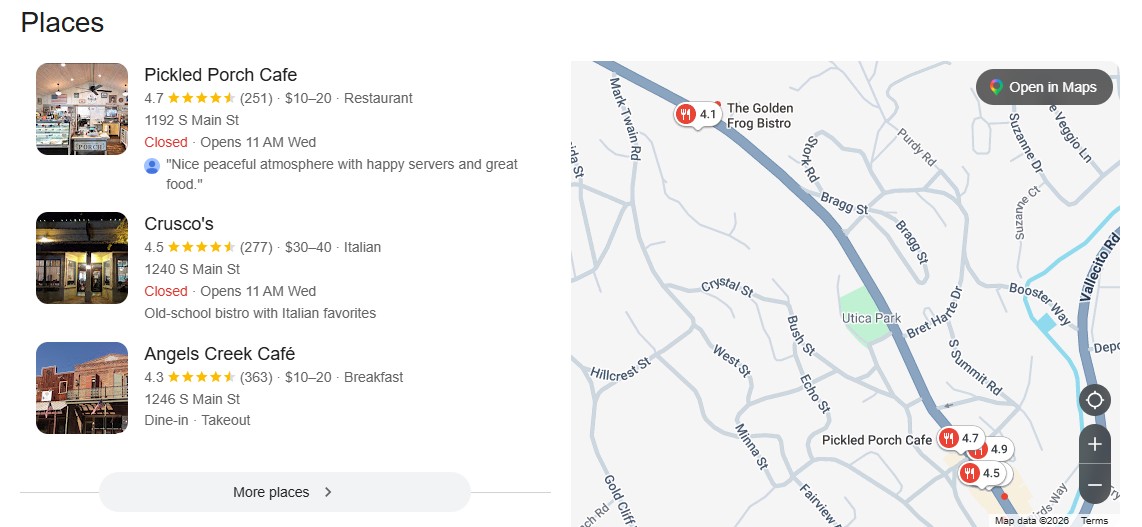
Google has done its best to offer business owners the chance to fill out their Google Business Profiles (GBPs) with as much information as possible. A basic profile can tell a potential customer what a business is called, where it’s located, when it’s open, what it looks like on the premises, what’s on the menu, what services are offered, and how the public rates the location.
This is, in fact, quite a bit of information, but what it lacks is the context of the needs of individual consumers. It’s a bit like the flat overhead map view, filled with helpful clues to what exists in the local commercial landscape, but missing the ability for a unique user to conveniently drill down to the specific details they need to make a decision. If their first search doesn’t turn up an obvious good match, they have to search again.
What AI-driven tools like Google AI Mode have done is to bring this landscape into contextual and interactive high-relief. Whereas traditional local search delivers basic local business information, AI Mode enables complex prompts like this one:
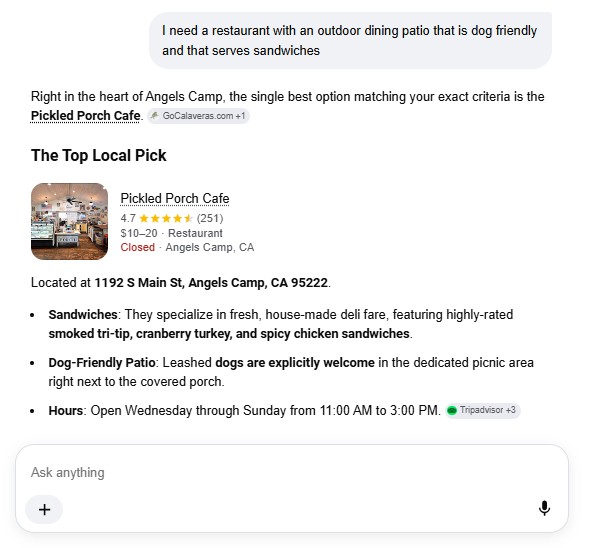
Now, instead of simply knowing that there is a nearby eatery called the Pickled Porch, the consumer can see that it meets their specific criteria of having an outdoor dining area, serving sandwiches, and being dog friendly. And, if they want to further refine their prompts, the tool retains the context of their original prompt, “remembering” that they are looking for dining spots in a specific location with specific amenities (something that traditional local searches can’t do):
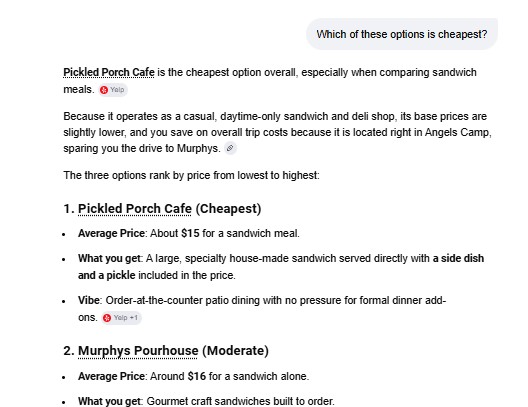
The conversation can continue until the user feels they have all the context they need to make the right decision for them:
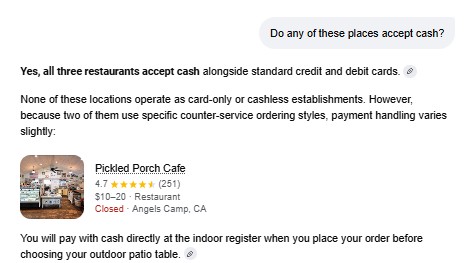
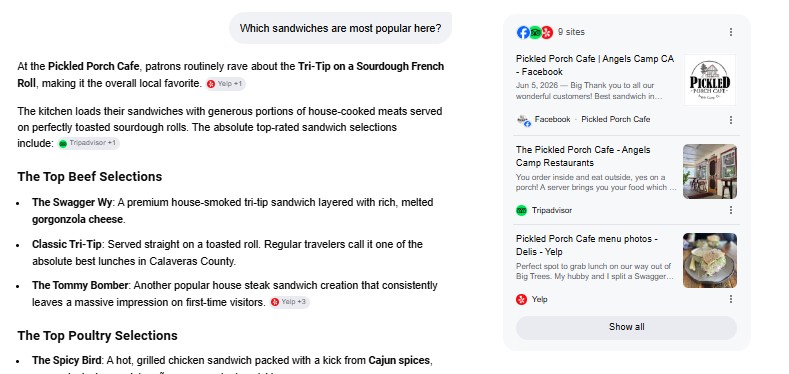
AI puts the user is in the driver’s seat in a whole new way, getting to decide when they are satisfied with the information they have been shown:
Just how hungry is AI for context?
You can answer this question yourself by starting to write a review for any local business. Find its Google Business Profile and click the “write a review” button. You’ll be shown the familiar popup asking you to choose a star rating, write your review, and, if you like, upload photos and videos:
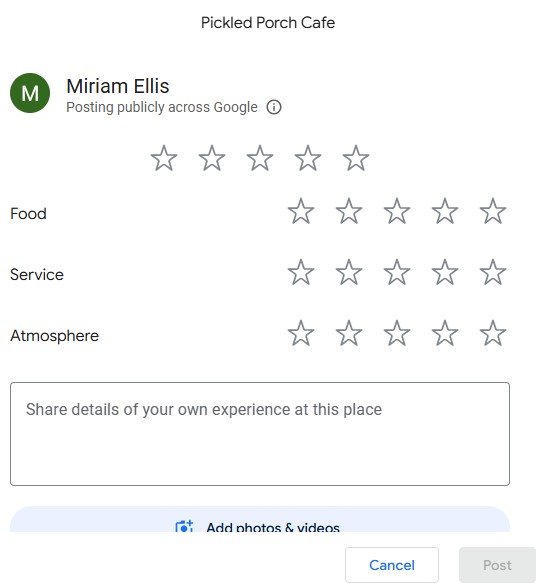
But keep scrolling and you’ll see clear signs of Google’s appetite for deeper information about the business:
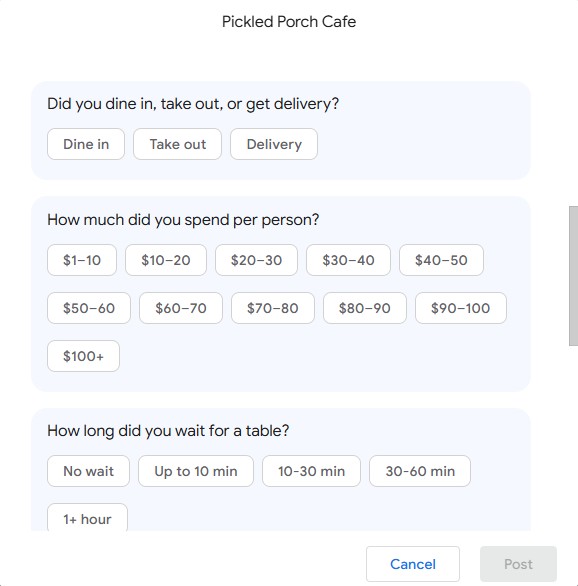
In countless GBP categories, Google is asking reviewers to answer additional questions like:
- Did you dine in, take out, or get delivery?
- How much did you spend per person?
- How long did you wait for a table?
- How would you describe the noise level?
In fact, if you keep scrolling, you will frequently uncover even further options for adding more detail to your review:
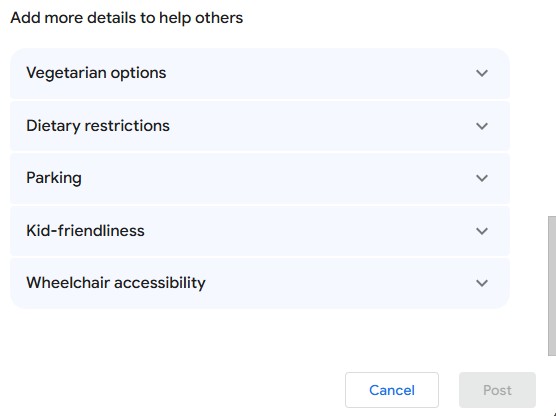
Each of these dropdowns reveals whole new sets of evaluations you can make as the reviewer, via a combination of pre-set labels and open-ended forms:
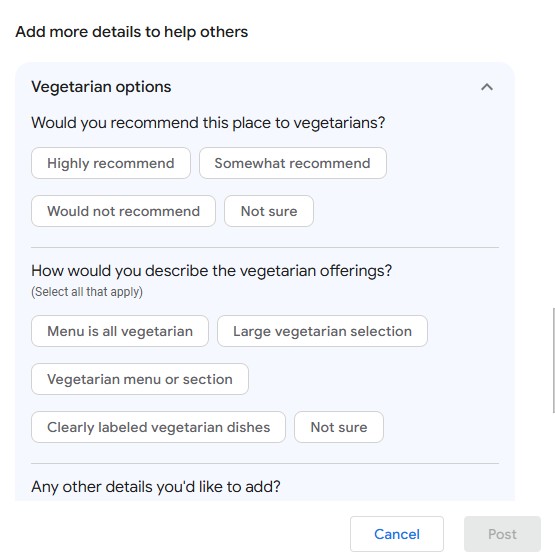
Why is Google going to such lengths to get every reviewer to give as much specific feedback as possible about their experience with a nearby business?
Because they are seeking abundant evidence that features of each location match the intents of future AI users.
Why does Google need this evidence? Because it is fueling features like their mobile Maps app Ask Maps functionality. In this setting, someone planning to be somewhere on a certain day at a certain time can see that the business is open when they want, serving the food they want, and featuring the amenities they want:
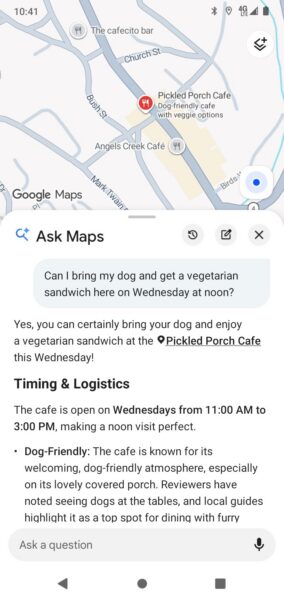
When Google’s AI lacks the necessary evidence to return a good answer to a user’s prompt, one of three things typically happens:
- The application will state that it doesn’t have enough information
- It will pull in information that is incorrect, outdated, and misleading to the user (e.g. recommending that a consumer visit a restaurant that is touted as “dog-friendly”, but which actually closed three years ago)
- The AI will generate nonsense; unfortunately, Google is so hungry to make its AI tools the go-to consumer choice that it has released products that are infamous for publishing errors
Gathering sufficient evidence for local AI prominence
GEO is the practice of optimizing your digital assets for maximum visibility in AI environments. A core focus of local GEO is ensuring that the internet is filled with enough detailed evidence about your business to give tools like AI Mode and features like Ask Maps the “confidence” they need to return you as a result across a huge array of consumer contexts. Think of it this way:
Our hypothetical user is looking for a pet-friendly, outdoor, vegetarian dining experience that accepts cash and is open next Wednesday at noon.
The same restaurant could be an equally good answer for user #1’s next-door neighbor who wants cozy indoor dining with a quiet atmosphere, wheelchair accessibility, and popular roast beef sandwiches on Friday at 2:00.
How can a single restaurant prove it is the best match for both potential customers? The answer is: evidence.
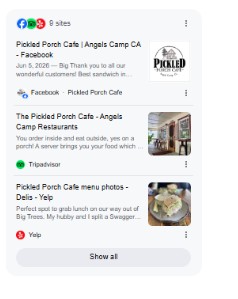
AI can pull lots of information from sources like your Google Business Profiles and website, but it’s become abundantly clear even at this nascent stage of development that environments like Google AI Mode and Ask Maps are leaning heavily on reviews to provide answers. You can quickly pick up clues to this simply from the few screenshots in today’s article, like this one in which Google AI Mode showed that it was scraping information from review sites like TripAdvisor and Yelp:
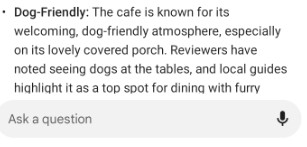
Or this one, where Ask Maps states that “reviewers have noted seeing dogs at the tables”:
Reviews are one of Google’s most valuable sources of local business information for AI users because they cover so many unique contexts, going far beyond the details contained in a simple Google Business Profile. Reviewers evaluate all kinds of things about each business they patronize, and AI’s ability to scrape all this evidence is what makes it a useful consumer research tool.
Your GEO review evidence checklist
Star ratings still matter. So do individual reviews. So does the recency of your review content. All these factors are still influencing consumer behavior.
What’s new is the opportunity to think more like customers and more like AI to be there with the right information at the right time for potential patrons near you. Use the following checklist to increase the availability, specificity, and helpfulness of review-based evidence relating to any local brand you’re marketing.
- Actively request reviews – 98% of consumers consult them before choosing a local business, and AI is scraping and summarizing them for users.
- Use review management software to templatize detailed review requests – Don’t send the same request to every customer; use a tool like GatherUp to ask patrons to leave feedback about fine details they experienced, such as specific menu items or services, atmosphere, price, and other attributes.
- Encourage consumers to include photos and videos in their reviews – Google can mine this media for further evidence, and is generating AI descriptions of images in its mobile Maps app.
- Broaden your review platform presence – It’s easy to over-focus on GBP reviews, but AI tools scrape review content from multiple platforms; be sure you are being represented and reviewed across an array of review sites.
- Repurpose review content across your socials – Google is now pulling social media profile content into GBPs, so be sure you have connected your social accounts to your listings and are bringing added attention to your best reviews by posting them on platforms like Facebook, Instagram, and YouTube; all of these sources can subsequently be scraped by AI as additional evidence.
- Adhere to platform guidelines – Prevent the loss of precious review evidence by avoiding any practices that are forbidden by review platform guidelines or law.
- Actively manage review fraud – An unfortunate outcome of AI is that it brings review spam to new prominence, misleading potential customers about your business; actively monitor all of your profiles so that you can report suspicious review content to platforms in hopes of removal.
- Use AI for local competitive reputation analysis – Investigate what environments like Google AI Mode and Ask Maps have to say about your direct competitors; find out what customers like and dislike about nearby brands to make operational adjustments to your own business for increased consumer satisfaction.
One of the smartest things any local brand or marketer can do right now is to put themselves in the customer’s shoes and see whether AI has enough evidence to provide accurate and helpful information across multiple contexts. What do people need to know about your business to choose it? Are your reviews providing enough evidence of all the most important aspects of your business in the eyes of your patrons?
If yes, it’s likely you’re already doing an excellent job with reputation management. If no, your investment in this GEO-ready form of marketing needs to be increased, because it will directly influence your visibility and profitability.
The next hurdle: review content validity
While GEO seeks to make the most of the new opportunities to present specific information to AI tool users with specific requirements, it’s important to know that there is a downside to all this generativity.
Just as most local brands have historically feared that GBP-based review spam would drive customers away, products like Google AI Mode and Ask Maps raise the same concerns and even worsen them because AI-generated summaries can look deceptively “official” to less-savvy consumers.
Consider the following screenshot in which a hotel is being cited by AI Mode as having “faced harsh customer complaints regarding outdated and unkempt facilities”:

If this is an accurate summary based on legitimate guests of the inn, then it offers a good warning for consumers who wish to avoid booking a dirty hotel room.
But what if the hotel is actually clean and this sentiment stems from fraudulent reviews purchased by a nearby competitor with the intention of promoting its own brand by making alternative local lodgings look uninviting? Review fraud is a massive problem and Google has never demonstrated the aptitude or motivation for effectively addressing the scale of it in their systems. Unfortunately, this scenario is now baked into conversational AI environments, too.
What’s at stake is public trust and brand profitability. Your first step is to implement a fake review defense system for your brand as a means of keeping as many fake reviews out of AI as possible.
But the larger question is whether more needs to be done to instill confidence in consumers that the review content they encounter either directly or in AI-generated summaries is valid. Stay tuned for more on this topic, and in the meantime, start a conversation this week at your brand or agency about Review Fraud: Why Your Agency’s Clients Are Going To Need A Reputation Defender in the AI Era.
We’re still in the early days of GEO. Many of your competitors aren’t even aware yet that consumer behavioral patterns and local search marketing strategies are shifting. Your education can deliver meaningful wins very quickly if you transition to providing the evidence for which people and AI have such a hungry appetite.
Want to talk through what evidence-based, GEO-ready reputation management looks like for your brand or your agency’s local business clients? Reach out for a conversation and a demo of GatherUp’s reputation management solutions today.