How will your local search marketing need to change if some or even all of your customers are navigating the nearby commercial landscape via a highly-personalized, AI-driven, agentic interface?
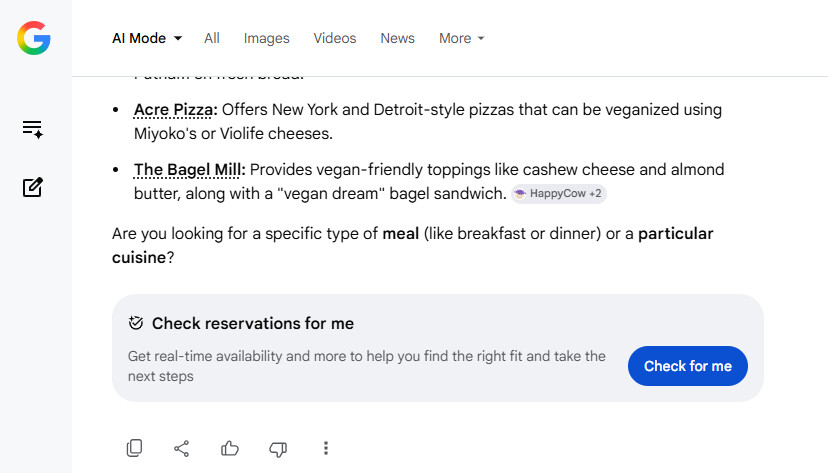
If the concept of agentic features is new to you, start by reading Defining Agentic Search for Local Businesses and Local Search Marketers. As I covered in that piece, the definition is a bit loose, but how many people define agentic features is that they help users complete multiple tasks, like calling multiple restaurants to find out whether they have open tables and then booking a table for them.
Right now, statistics trying to capture the actual adoption of AI and emergent agentic features vary, and frankly, actual data on this is likely to be unique to your business and its customers. Locality, industry, median customer age, tech savvyness, and other factors will all play into how widely your specific consumer base adopts these technologies as a part of their daily lives.
What we’re going to do today is give a glimpse of how it might look if your customers become heavily-dependent on this type of technology in future. Think of this as a possibility, rather than a given, with the point of reading this article being that you are keeping up with nascent developments which could increasingly shape your local search marketing strategy.
The Big Pool of Traditional Local Search vs. An Individual Swim Lane For Every Customer
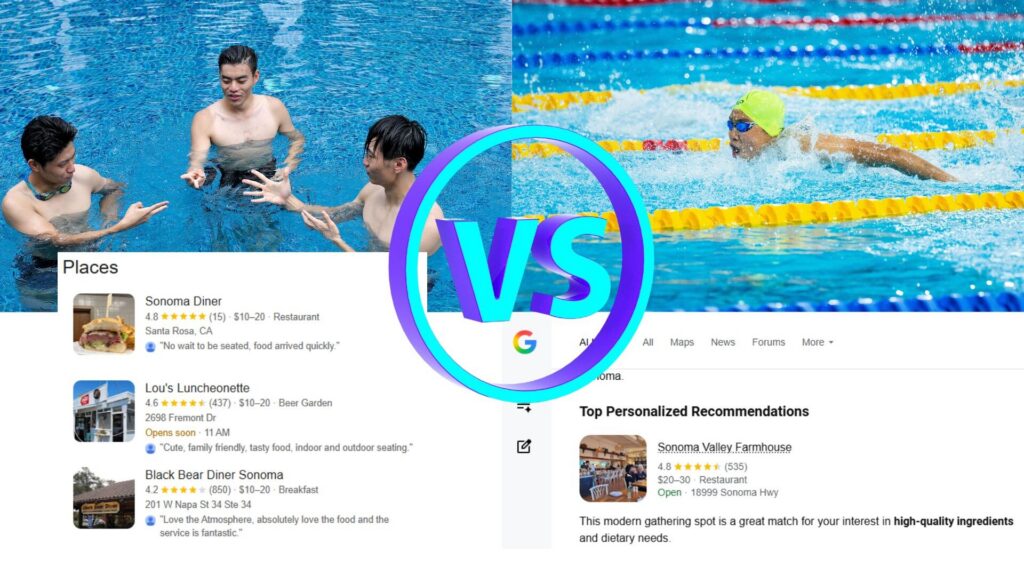
Local business owners and their marketers are already accustomed to the idea that Google personalizes local search results on the basis of searcher location. A customer downtown searching for “diner near me” will see a different local pack/Google Maps results than one doing the same search in a suburb at the edge of the city. This is familiar ground.
Even with this kind of customization, however, local packs and maps have felt kind of like a big public pool. You could get a fairly accurate sense of how your business ranked for anyone anywhere in the pool by either:
- Using a local rank tracking emulator
- Taking your phone to different parts of town and searching for your brand and important keywords
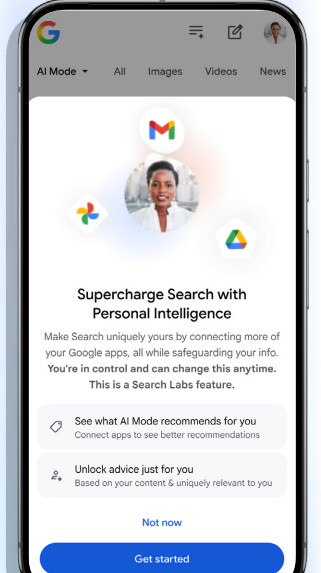
Now Google has a different vision. I highly recommend watching NearMedia’s interview of Garrett Sussman on the concept of Personal Intelligence for a deep dive into this, but in a nutshell:
- Google has rolled out a beta version of Personal Intelligence in the Gemini app
- By opting into this program, consumers are allowing Google to access everything about them, including the contents of their emails, their search history, your photos, your YouTube history, etc.
- Google offers this as an example of how consumers might benefit from opting into PI: “…when you ask the Gemini app to “Plan a list of restaurants for my upcoming trip that are near my hotel”, with Personal Intelligence, you won’t just get generic top-rated spots. The Gemini model understands that this task requires synthesizing disparate personal details from across Google products — your hotel reservations, flight arrival time, past dining history, and the aspirational spots you’ve saved.”
Doubtless, Google’s aims are profit-driven, and a future path for a local consumer could look like this:
Google knows everything about a consumer > When the consumer wants to do something, AI will make personalized recommendations > Google offers agentic functions to accomplish tasks for the consumer like booking or buying something
Like most of the marketing pitches since the beginning of commerce, it’s a value proposition of convenience.
Will Google’s dreams for this come true? This remains to be seen. In the NearMedia interview, Garrett Sussman mentions how uncomfortable he was realizing that Google had information about his child’s birthday party because it had been mentioned in an email when he opted into the PI program. Greg Sterling, meanwhile, sounds an even louder alarm bell when it comes to ethical concerns surrounding PI and whether he would want to use it:
“…Absolutely not. My response was no f-ing way am I going to do this…as a consumer, as a person, it’s like Google is already too intrusive and too manipulative. And I don’t want to give it any more of my information because not only do I not trust Google, but then Google just becomes a conduit for all the bad actors out there where they can go in and say, hey, Google, give us all this data. I mean, it’s already happening in the current government. Give us all this data about critics and dissidents and all of this.This is a China scenario.”
Both Sussman and Sterling are experienced tech professionals with highly-educated opinions about the motivations and trustworthiness of an entity like Google. What remains to be seen is whether average consumers:
- Find AI, in general, to be of lasting value rather than it being a passing fad
- Find PI convenient or too creepy to adopt
- Feel sufficient trust in agentic tech to give it their banking information and other details to carry out tasks
Apart from ethical concerns, one of the major challenges this projected potential future holds for local business marketers relates to tracking. Local rank tracking emulators have made it possible for your brand to understand your local pack/Maps visibility for consumers across a variety of physical locations. If some or all of your consumers end up in their own AI/PI-driven swim lanes, seeing highly personalized local business recommendations, there are, as yet, no tools for tracking these types of customer journeys.
How would this affect your local search marketing strategy? It’s likely your brand would feel obliged to invest more in paid advertising to secure visibility in unique consumer swim lanes. It is also possible that the tech brands leading this charge could sell consumer tracking data to subscribers desperate for any insight into the big black box being created by AI.
What role could reputation play in an AI-PI-agentic feature?
Right now, the reviews and ratings your brand is earning across multiple review platforms are playing a critical role in your visibility in environments like Google AI Mode.

It’s essential to invest in full reputation management to make the most of signals like average star rating, review recency and velocity, and review content to be seen as a relevant response to countless local consumer prompts.
In an agentic context, aspects of your reviews can also contribute to the initial visibility of your brand, but you may also need to opt into certain programs like Reserve with Google so that agents can complete tasks related to your business for consumers. Ultimately, the consumer will make the decision about where they want to eat in an example like this one, meaning that your reviews have the power to persuade potential customers to choose you over a competitor with a lower rating, worse sentiment, or a menu that does not match what they want to eat.
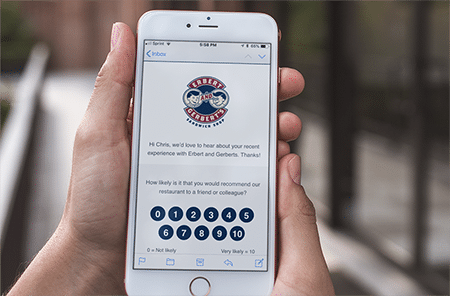
In a Personal Intelligence context, the concept of reputation broadens significantly. Imagine that your customers have opted into PI, and an email like this is sitting in their inbox:
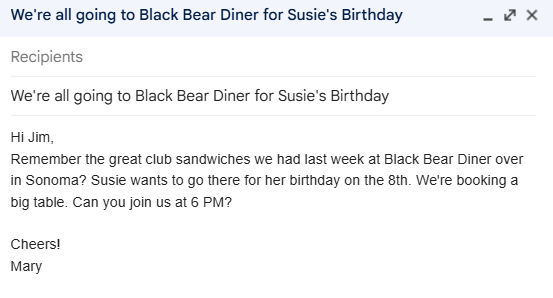
This is not a formal review on a review platform, but if Google is tracking this customer’s email communications, they now know that he and his circle like this diner, and this information can be used to recommend destinations for future meals.
What emerges from this dynamic is a future in which the importance of having current customers speak well of you to both the general public and their personal connections. This, then, boils down to offering such excellent customer service that your patrons talk about you wherever they go on the web.
Consumer preference will drive the future
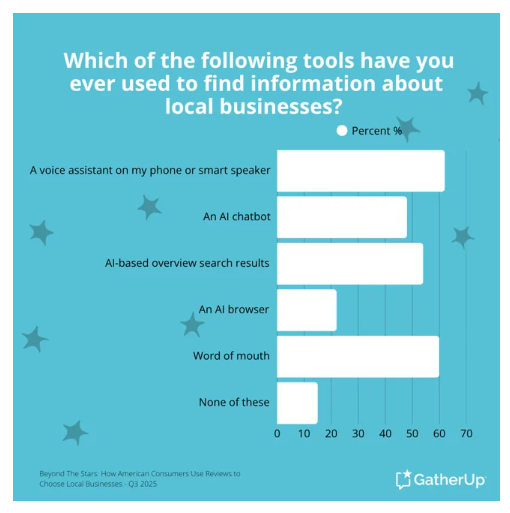
In our most recent consumer behavior study of 1000+ US adults, GatherUp found that 48% of respondents had experimented with using conversational AI. Let’s imagine that this is about ½ of your brand’s customers currently seeing whether or not they find tools like Google AI Mode to be useful. In a future survey, we will doubtless ascertain not only how these numbers have altered over time, but also, how many respondents are using agents to handle local tasks for them like calling businesses for price quotes or booking tables. We may also have the opportunity to find out whether our respondents are opting into PI, depending on whether that has come out of beta by the date of our next major survey.
GatherUp strongly believes in polling the consumer public because it is customers who will determine the technological future. Products consumers adopt will stick, while many others will fail.
No one can accurately predict right now the degree to which each of your customers will end up in a completely personalized swim lane. But you are already ahead of the game because you have read this article and know that this could be what the future looks like. Many of your nearby competitors aren’t even thinking about this yet, and are not putting in the necessary work to ensure that their reputation will serve them well across multiple potential tech evolutions.
Are you talking about reputation on a regular basis at your all-hands meetings? Would it help to speak to GatherUp’s team, where these kinds of conversations are at the center of all we are doing every day amid so much technological change? Reach out to us for a conversation and a demo of our reputation management solutions today.