There was something really special about this most recent GatherUp conference. Not only did it bring together on-the-ground agency leaders who eagerly shared their playbooks for how reputation is shaping AI visibility and agentic search, but it included some very special speakers, like one of the two lawyers who wrote the new FTC ruling on review fraud. This is high-quality information you can put into action, today, whether you’re trying to build your agency or market your own local brand.
Here are your highlights:
Build, Manage, Defend with Michael Yules
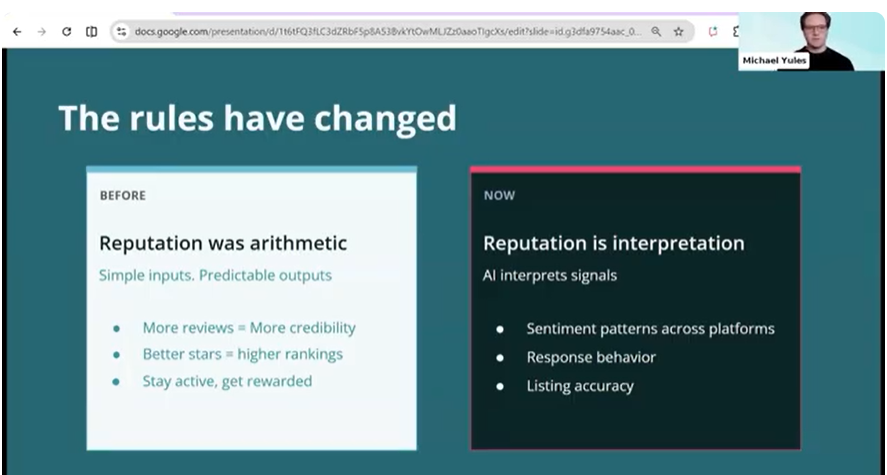
The conference kicked off with a keynote from GatherUp CEO, Michael Yules, describing how AI has caused the visibility of local business reputation to shift from simple arithmetic based on metrics like review counts signalling credibility, star ratings influencing rank, and activity being rewarded, to an interpretive dynamic being fueled by multi-platform sentiment, owner response behavior, and listing accuracy. It isn’t that the old factors don’t matter, but AI is looking beyond them to broader patterns, Yules explained.
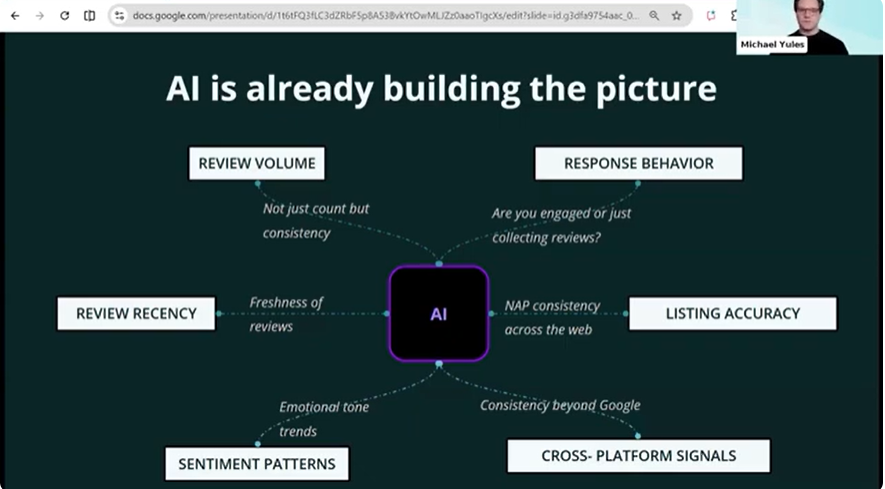
A more comprehensive illustration of what AI is taking into account can be seen in this slide:
Michael highlighted the 3-part strategy GatherUp is seeing deliver AI visibility for our customers:
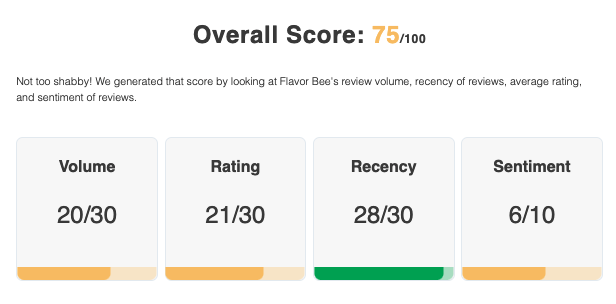
- Build – Proactively generate signals to establish trust and authority and making sure that we establish that credibility with consumers, AI, and AI agents. This revolves around publishing accurate and fully-fleshed-out listings across multiple platforms, earning first-party feedback that’s rich, specific, and detailed, and developing balanced and diverse signals like review volume, rating, recency, and topic breadth.
- Manage – Manage listings across all platforms, including both the majors and industry-specific ones, respond to all reviews (not just negative ones), and pay close attention to sentiment trends surrounding your business.
- Defend – Act quickly to report review fraud on both your own assets and across your competitive landscape, before it settles too deeply into the system, and comply with all platform guidelines to avoid penalization
Michael concluded with explaining how GatherUp is evolving to meet the moment with always-own capabilities to assist with all three components of the build-manage-defend strategy:
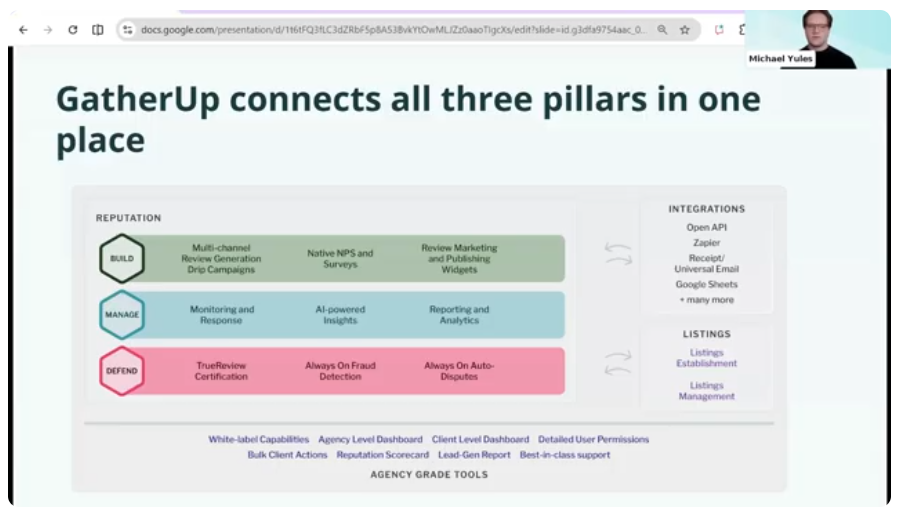
Particularly at the agency or enterprise level, the more assistance your tools are giving you in reputation management, the less likely you are to overlook vital information about emergent problems and month-over-month performance.
The ROI of Reviews with Brad Wetherall
Next up, former Director of Operations at Google, Brad Wetherall, urged attendees to think of local business visibility in two parts as it relates to review content:
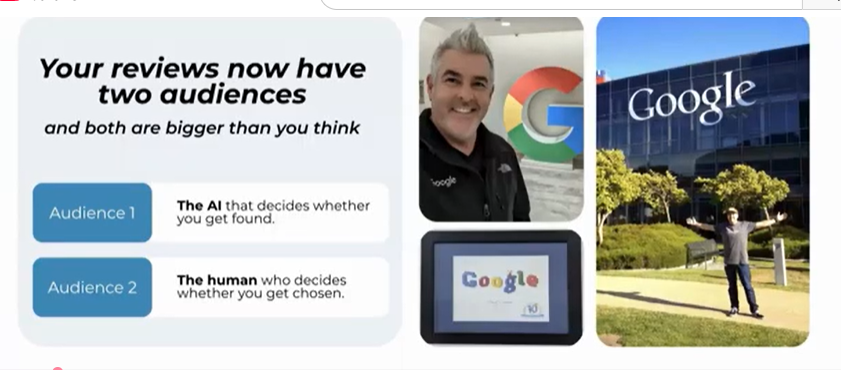
- Audience 1 is the AI that decides whether you get found
- Audience 2 is the human who decides whether you get chosen
Brad shared the following statistics that capture Google’s march towards an AI-first strategy: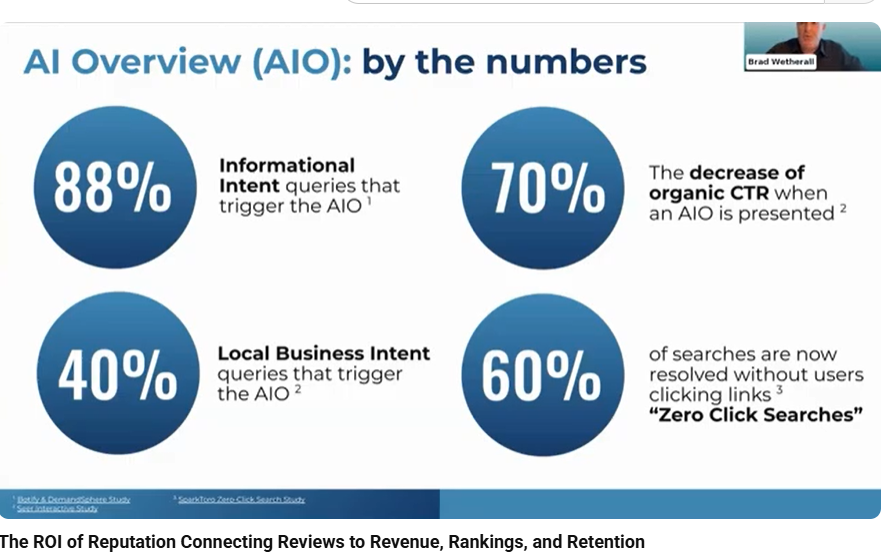
- 88% of informational queries are triggering Google AI Overviews (AIOs)
- 40% of queries with a local intent trigger them
- There is a a 70% decrease in clickthrough rates (CTR) when an AIO is present
- 60% of searches are now zero click, meaning that users don’t click on anything after they’ve searched
These are some pretty staggering stats! Yet, Brad suggested that the familiar signals of experience, expertise, authoritativeness, and trustworthiness (E-E-A-T) continue to play into AI visibility, specifically concerning reviews.
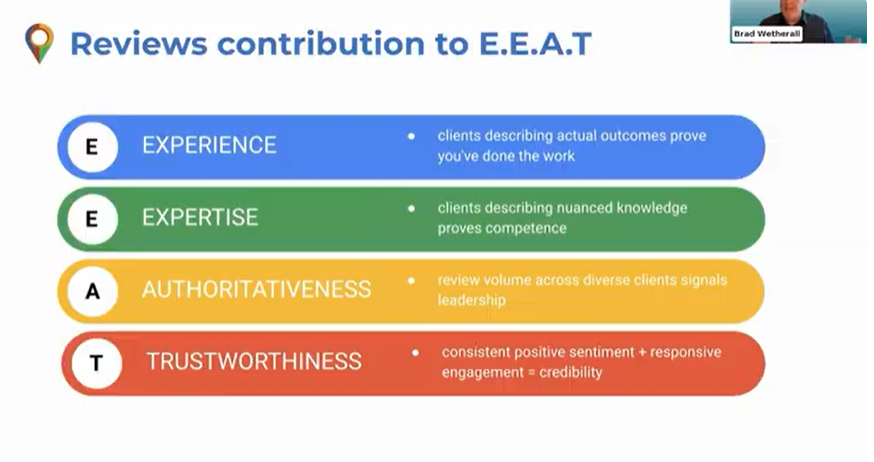
In brief, your reviewers’ content can cover all four aspects of E-E-A-T. Moreover, Brad explained, Google is pulling aspects of your reviews into multiple consumer experiences, including features like:
- Local justifications
- AI-driven business description summaries
- AI-driven service descriptions
- AI Review summaries
- Ask Maps/Ask A Question
Finally, Brad shared the following statistics surrounding why review management provides such a high degree or return on investment:
- 97% of consumers read local business reviews but 74% only care about reviews written in the last 3 months, highlighting the need for review acquisition practices that deliver a continuous stream of fresh sentiment
- Conversion rate can increase up to 33% for businesses that reply to reviews vs. those that don’t
What the FTC’s consumer review rule means for your brand with former FTC Senior Attorney Michael Atleson
This session offered a rare and valuable chance to hear directly from a professional who contributed to the creation of this sweeping FTC rule, which went into effect in October of 2024. As Michael stated:
“Fake reviews are prevalent and hurt not only consumers, but honest businesses…a rule gives the FTC more power via civil penalties for known violations and hopefully a stronger disincentive, at least for bad actors within US jurisdiction.”
Michael drew special attention to a few specific aspects of the new rule that every local business owner and marketer should be aware of to avoid civil penalties:
- Creating, selling, or buying fake consumer reviews
- Providing money or other incentives contingent on writing reviews expressing a particular sentiment, whether positive or negative
- Failing to make disclosures about certain insider reviews, like when officers or managers of a business write reviews (most platforms forbid insider reviews, but Michael explained that the FTC ruling only covers failing to disclose when a review is written by an insider like an office manager)
- Misrepresenting that a set of reviews (like on a website) are all the reviews the business has received when, in fact, some sentiment has been suppressed
Overall, a core tenet of reputation defense is avoiding any practice covered in the ruling or any activity that is meant to deceive consumers. No local business can afford negative publicity surrounding a civil penalty – especially when you consider that this kind of damaging content can feature highly in AI outputs about your brand. It’s just not worth the risk to bend or break FTC rulings or platform guidelines and multiple speakers at AmpUp remarked that they are seeing evidence of an increased crackdown on violations.
Selling review defense as an agency, with AJ Rivera and Mike Schmidt
This duo of speakers who co-founded Agency Coach directly addressed agency owners in pointing out that, while much AI buzz surrounds its capabilities for legitimate businesses, it is also a superpower for spammers and scammers. Meanwhile, regulation has become stricter as a result of new factors like the FTC rule covered by Michael Atleson. This has created a landscape in which brands need professional assistance with reputation defense.
Rivera and Schmidt surfaced the following ways in which AI can be used by agencies to identify potential review fraud:
- Review pattern analysis
- Distance data
- Network mapping
The speakers shared the following framework for creating a lucrative agency reputation defense offering.
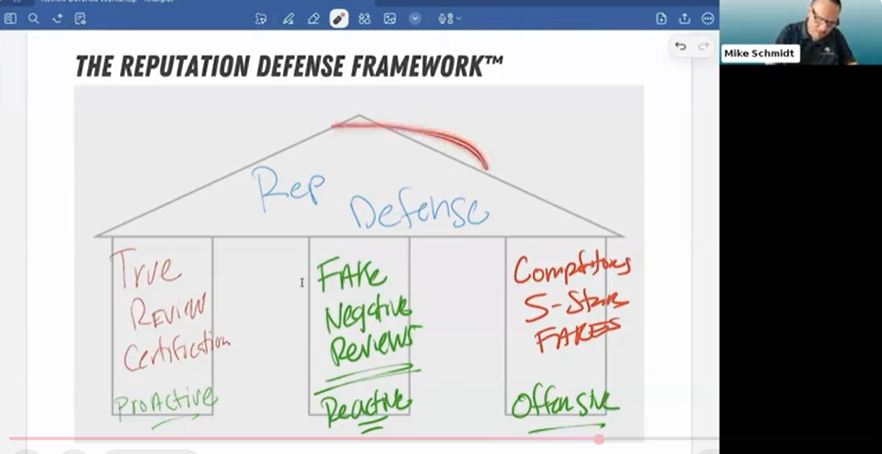
This offering hinges on:
- Taking a proactive stance on your brand’s review validity. Consumers will increasingly mistrust review content, and Schmidt pointed out that a program like GatherUp’s Review Defense Sofware is precisely positioned for this development, instilling consumer trust in the legitimacy of brand reputation.
- Taking a reactive stance on fake negative reviews. Don’t let unearned bad press slip by. Report them to the platforms they exist on and advocate for removal.
- Taking an offensive stance on fraudulent competitors. Don’t hesitate to report your competitors’ suspicious profiles. It helps Google, protects your community, and defends your visibility in both traditional and AI environments.
How to spot and report suspicious review content, with Jason Wortham
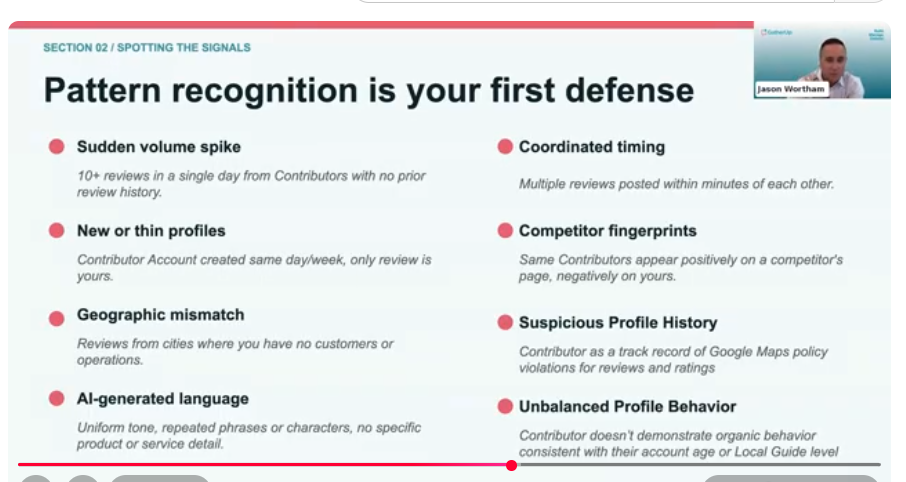
GatherUp’s VP of CX, Jason Wortham, shared the screenshot, above, summarizing top suspicious review patterns the company sees, including:
- Sudden spikes in review volume
- Reviews left by new profiles or ones with few other reviews associated with them
- Reviews from cities where you have no operations
- Reviews that seem generic rather than specific and sound as if they may have been AI-generated
- Multiple reviews arriving within minutes of one another, suggesting coordinate timing
- But before you can begin researching any of these patterns, the key is to be continually alerted to incoming reviews. You’ll quickly notice strange spikes and other suspicious signals if your reputation management software is built to keep you in-the-know.
Once you suspect a problem, here is your four-step playbook for taking action to defend your brand:
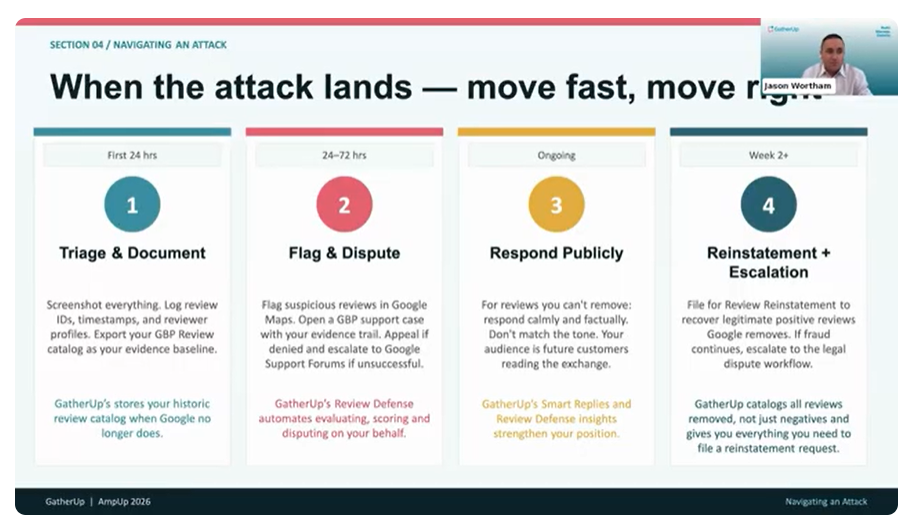
- Triage & Document – Catalog all of your reviews. All of your reviews need to be stored off of Google Maps. GatherUp does the documentation for you, so that you know everything, like profile IDs and timestamps.
- Flag & Dispute – Flag suspicious reviews in Google Maps and open a support case in which you share your documented evidence. If your request for review spam removal is denied, use the appeals process and attempt to escalate your help request via the Google Business Profile Community Help forum.
- Respond Publicly – If your efforts fail to convince Google to remove review content you know is fake, use the owner response function to calmly remark that the review has been reported to Google.
- Reinstatement & Escalation – If Google has removed legitimate reviews from your profiles, file for review reinstatement.
Google won’t always respond, even in cases of clear spam, but the more work you do for them, backed up with good documentation, the better your brand’s chances of achieving a positive outcome.
The New Customer Journey Starts with Reviews, with Chris Snellgrove
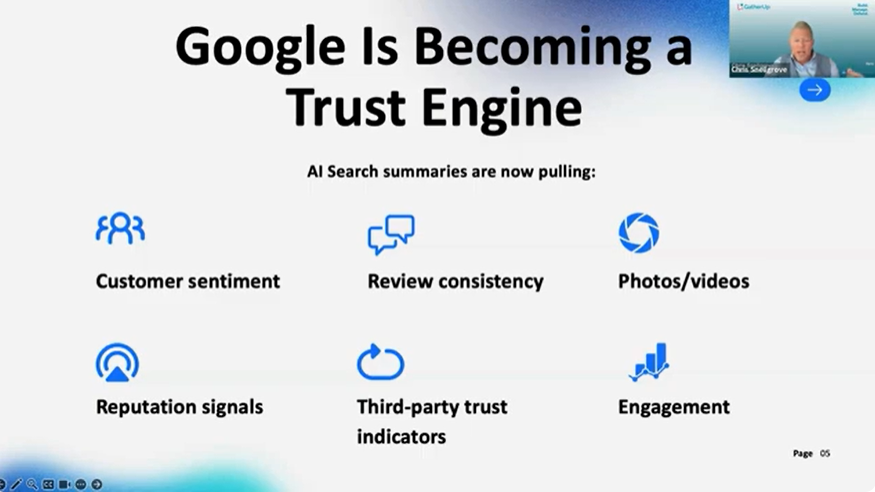
AI environments are prioritizing consumer sentiment from a variety of sources, creating new journeys for your potential customers in which they are turning to tools like Google AI Mode and ChatGPT to find out which brands they can trust. CEO of Reputation Sensei, Chris Snellgrove, pointed to these sources of information that Google is currently pulling into AI search summaries:
- Customer sentiment
- Review consistency
- Photos and videos
- Reputation signals
- Third-party trust indicators
- Engagement
Chris said that most businesses are failing to make the most of how reviews drive AI visibility because they are asking too late in the journey, they ask inconsistently, they are overfocused on stars instead of emotional storytelling, and they aren’t repurposing review content across all their marketing channels.
Chris urges brands to move from thinking of marketing as promotional, to reenvisioning it as a source of proof that consumers trust. Here’s his playbook for reputation growth that will increase AI visibility:

-
- Start with an audit of your current trust signals, including your customer service quality, what your reviews and testimonials say about your brand, how well you respond, and what your present review velocity is.
- Create a process based on consistent and early review requests and ethical automation.
- Train staff on the basis of reviews, reading them aloud to find the stories that are being told about your business and to ideate how your teams can improve the narrative.
- Continuously repurpose reviews via social media, your website, ads, and email media.
- Measure trust like a key performance indicator (KPI) by tracking review velocity, response rate, conversion lift, and AI visibility
Up Next
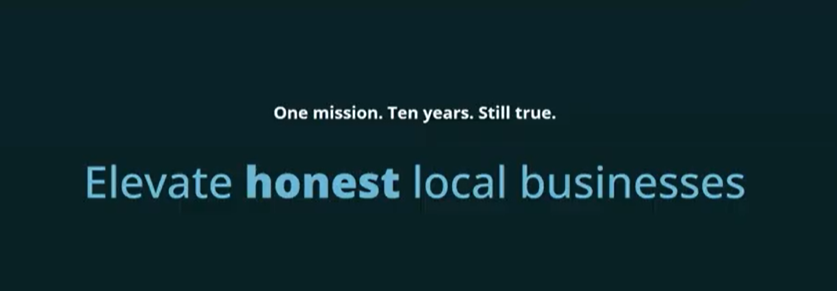
Michael Yules closed the conference with the excellent reminder that what ethical brands like GatherUp exist to elevate honest local businesses. Whether you’ve been marketing local brands for decades or have just started on this journey, your top takeaway here is that consumer behaviors will be increasingly driven by trust.
Given this, you need to treat customers fairly and help them to speak well of you wherever they go on and off the web. You need dependable tools because reputation will increasingly drive your brand’s revenue. There’s nothing to fear in this, but there is certainly a lot of opportunity!
Ready for a deeper dive? Read next: Review Recency as Reputation Defense