

AI tools like ChatGPT decide which businesses to mention before they decide which websites to link to.
If your Google Business Profile doesn’t clearly explain who you are and what you offer, you may be left out entirely because local search didn’t quietly evolve. It switched operating systems.

If you’re still thinking about local SEO as a race to blue links, landing pages, and “near me” modifiers, you’re already behind. AI-powered discovery tools like ChatGPT are changing how local intent is answered, where decisions are formed, and which data sources win.
The uncomfortable truth for many marketers is this: AI systems are resolving entities before they surface websites.
And for local businesses, that changes everything.
The Shift Some Marketers Missed
When users ask ChatGPT questions like:
- “Best hotel downtown”
- “Family-friendly dentist near me”
- “Top-rated HVAC company in Phoenix”
The system is no longer starting with a crawl of the open web.
Instead, it’s grounding answers in structured local business entities, primarily sourced from Google Business Profile (GBP) data and related trusted local indexes.
This isn’t speculation. It’s consistent with:
- Google’s long-documented entity-first understanding of local search
- OpenAI’s public explanations of grounding and tool-based retrieval
- Observed behavior in ChatGPT responses for location-intent prompts
The implication is stark:
If your Google Business Profile is incomplete, inconsistent, or poorly governed, you are invisible at the moment of AI-driven intent.
Not outranked. Not second page. Invisible.
Why GBP Became the System of Truth
Google has been explicit for years about how local search works.
In Google’s own documentation, local results are determined by three primary factors:
- Relevance
- Distance
- Prominence
Prominence is heavily influenced by:
- Business information completeness
- Review volume and recency
- Category accuracy
- Engagement signals
Source: Google Search Central, “How Local Search Ranking Works”
What’s changed isn’t Google’s model. What’s changed is who is consuming Google’s local data.
ChatGPT isn’t replacing Google Local. It’s using Google Local as fuel.
Google Business Profile has effectively become:
- A normalized local entity database
- A trusted, structured source
- An API-like reference layer for AI systems
That makes GBP no longer a “listing.”
It’s an infrastructure.
Discovery Is Happening Before the Click
This is the most dangerous part for brands that are behind.
In AI-driven interfaces, users often:
- Form preferences
- Shortlist options
- Decide who feels trustworthy
Before they ever click a website.
This mirrors what we’ve already seen in:
- Google’s zero-click search behavior
- Local Pack dominance
- Map-based discovery
But AI compresses that journey even further.
If ChatGPT surfaces three hotels with:
- Complete amenities
- Strong review sentiment
- Clear policies
- Consistent brand signals
And your location isn’t one of them, the decision has already been made.
No click was lost. The opportunity never existed.
Clarity Beats Content Volume
Traditional SEO rewarded:
- More pages
- More keywords
- More internal links
AI-local discovery rewards:
- Clean entity data
- Consistency across sources
- Structured attributes
- Trust signals
This is why multi-location brands with strong governance are appearing disproportionately in AI-driven local answers.
They don’t win because they’re bigger. They win because their data is machine-readable, consistent, and reliable.
AI systems are pattern-matching entities, not admiring prose.
Reviews Are Now AI Training Signals, Not Just Social Proof
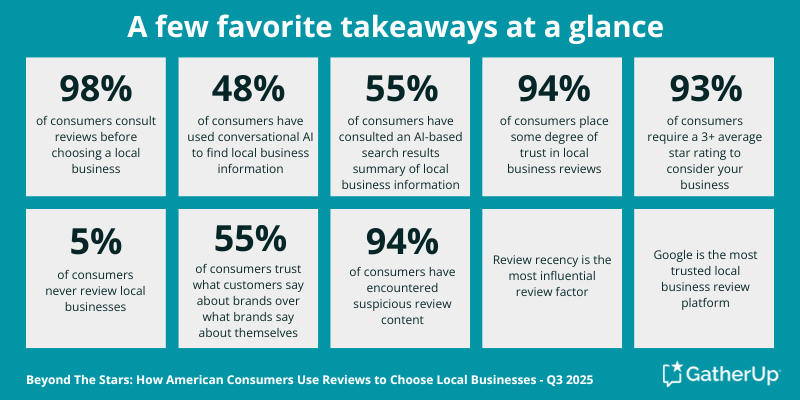
Reviews have always influenced conversion. Now they influence inclusion.
Public research consistently shows:
- Google reviews are the most trusted review source for local decisions
- Review volume, recency, and sentiment impact local visibility
Source: GatherUp, “Beyond the Stars: How American Consumers Use Reviews to Choose Local Businesses” (Aug 2025)
What’s new is how AI interprets them.
AI systems don’t just look at:
- Star ratings
They evaluate:
- Language patterns
- Recency
- Topic clustering
- Response behavior
And they penalize:
- Generic descriptions
- Stale profiles
- Unanswered reviews
- Inconsistent attributes
In other words, reputation hygiene is now a retrieval signal.
Why “Good Enough” GBP Optimization No Longer Works
Many brands still treat GBP like a task to check off:
- Add hours
- Pick a category
- Upload a logo
- Respond to a few reviews
That approach was already weak in Google Local.
In AI-driven discovery, it’s fatal.
AI rewards:
- Attribute completeness
- Location-aware descriptions
- Consistent amenities
- Active management
It punishes ambiguity.
A business that looks “fine” to a human can look unreliable to a model.
The Scaling Advantage (and Risk) for Brands
Brands now face a clear fork in the road.
Brands with governance
- Centralized GBP management
- Standardized categories and attributes
- Review response systems
- Ongoing data hygiene
These brands compound visibility.
Brands without governance
- Location-level drift
- Inconsistent categories
- Missing attributes
- Stale photos and policies
These brands leak demand to:
- Aggregators
- Online Travel Agencies (OTAs)
- Direct competitors
AI doesn’t forgive inconsistency. It routes around it.
What Marketers Should Do Now (This Is Table Stakes)
This is not optional optimization. It’s AI-era distribution hygiene.
1. Treat GBP as a Conversion Surface
Not a listing. Not a citation.
Your GBP must answer:
- Can I trust this business?
- Does it fit my needs?
- Is it active and legitimate?
That includes:
- Calls
- Directions
- Booking links
- Messaging
- Policies
- Photos
These signals now live inside the AI decision layer.
2. Enforce GBP Governance at Scale
Every location should have:
- Consistent categories
- Standardized attributes
- Location-aware descriptions
- Regular photo updates
One rogue location can weaken the whole entity graph.
3. Align GBP With Structured Data (Schema.org)
Your website schema and your GBP should agree.
Same:
- Business name
- Address
- Categories
- Amenities
- Brand signals
AI systems reward consistency across trusted sources.
4. Stop Treating Reviews as a Marketing Output
They are now:
- Trust signals
- Visibility inputs
- AI interpretation material
Volume, recency, and response quality matter more than perfection.
How to Prove This Yourself (Run This Test)
If you want your own data, here’s a clean, defensible test you can run.
Step 1: Identify Location-Intent Prompts
Examples:
- “Best [category] near me”
- “Top-rated [service] in [city]”
- “Family-friendly [business type] nearby”
Step 2: Query ChatGPT Consistently
- Use the same prompts
- Log responses weekly
- Capture which businesses appear
- Note attributes referenced
Step 3: Compare Against GBP Quality
For businesses that surface analyze their:
- Review volume and recency
- Attribute completeness
- Category accuracy
- Photo freshness
Patterns will emerge quickly.
Step 4: Track Traffic Separately
In GA4:
- Create UTMs for Google Local links
- Monitor ChatGPT referrals
- Segment AI-driven traffic
You’re not measuring “SEO.” You’re measuring AI discovery.
The Hard Truth
ChatGPT didn’t break local search. It exposed who never took it seriously.
Google Business Profile is no longer a supporting actor in your strategy. It’s the local API for AI systems.
If you’re just learning this now, you’re behind.
But catching up is possible, if you stop treating reputation, reviews, and local data as afterthoughts and start managing them like infrastructure.
Stay Ahead of the AI Discovery Curve
AI-driven local discovery is evolving fast, and the rules are being written in real time.
If you want to stay informed on:
- How AI systems interpret local data
- What changes actually matter
- How marketers adapt before visibility is lost
👉 Book a demo to see how GatherUp helps you turn reputation into growth.
The era of passive local presence is over. The era of governed, AI-ready reputation has begun.